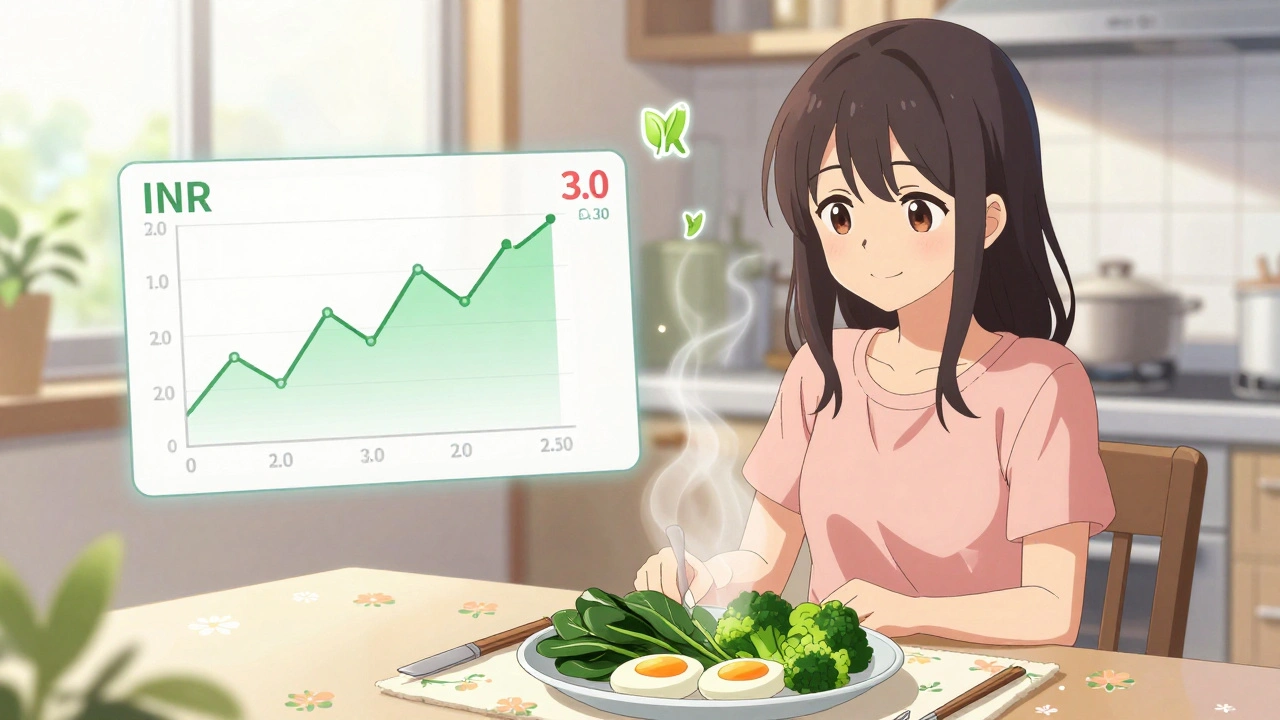
When you’re on warfarin, your life doesn’t stop-but the way you eat might need to change. Not because you have to give up spinach or kale, but because warfarin and vitamin K are locked in a quiet chemical battle inside your body. Get the balance right, and your blood thins just enough to prevent clots. Get it wrong, and you risk dangerous bleeding or a stroke. The key isn’t avoiding vitamin K. It’s keeping it steady.
Warfarin works by blocking a protein called VKORC1, which your liver needs to recycle vitamin K. Without enough recycled vitamin K, your body can’t activate clotting factors II, VII, IX, and X. That’s the goal-to slow clotting just enough. But vitamin K from food-mostly from leafy greens, broccoli, and some oils-directly fights back. It pushes those clotting factors into action again. So if you eat a big bowl of kale on Monday and nothing green all week, your INR swings like a pendulum.
The INR (International Normalized Ratio) is the number your doctor watches. For most people, the target is between 2.0 and 3.0. If your INR is too low, clots can form. Too high, and you bleed too easily. Studies show that people who eat inconsistent amounts of vitamin K are 2.3 times more likely to have INR levels that jump out of range. That’s not just inconvenient-it’s dangerous.
You don’t need to cut back on vitamin K. In fact, cutting back can make things worse. The National Academies recommend 90 mcg per day for women and 120 mcg for men. Most Americans already hit that mark. The problem isn’t eating too much-it’s eating too much one day and too little the next.
A 2015 study in Blood gave 150 mcg of vitamin K daily to patients with unstable INRs. Their time in the target range jumped from 58.4% to 65.6%. No extra bleeding. No side effects. Just more stability. Meanwhile, the American College of Chest Physicians updated its guidelines in 2021 to say: “Dietary vitamin K restriction is not recommended and may be harmful.” Restricting vitamin K can actually cause your body to become more sensitive to small changes, making your INR even wilder.
Think of it like a thermostat. If you crank the heat up one day and turn it off the next, your house temperature swings. But if you keep it steady at 72°F, everything runs smoothly. Same with vitamin K.
You don’t need a PhD to track this. Here’s what really matters:
Notice something? Spinach and kale are packed with vitamin K. But so are Brussels sprouts, cabbage, and green tea. You don’t have to avoid them. You just need to eat about the same amount each week.
Some people think they can eat a huge salad on Monday and then skip greens for the rest of the week. That’s a recipe for INR chaos. Instead, aim for a consistent daily dose-even if it’s small. One cup of mixed greens, two or three times a week, spread evenly, gives your body a steady signal. That’s all it needs.
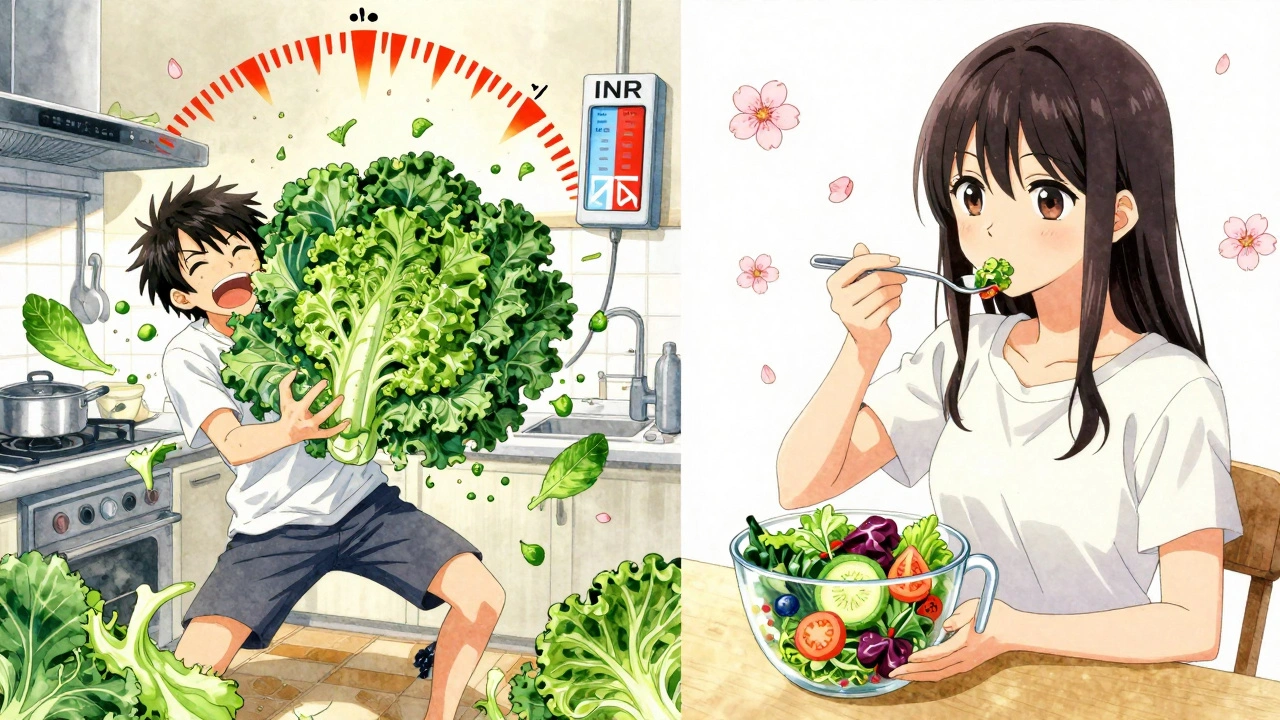
Reddit user u/WarfarinWarrior shared their story: their INR was all over the place-sometimes 1.8, sometimes 4.5. They were terrified. Then their pharmacist gave them a simple sheet: eat exactly one cup of mixed greens every Tuesday and Thursday. No more guessing. No more guilt. Within weeks, their time in range jumped from 45% to 78%.
A survey by the National Blood Clot Alliance found that 57% of emergency visits due to INR instability were linked to inconsistent vitamin K intake. That’s more than blood pressure, missed doses, or alcohol. Diet is the silent saboteur.
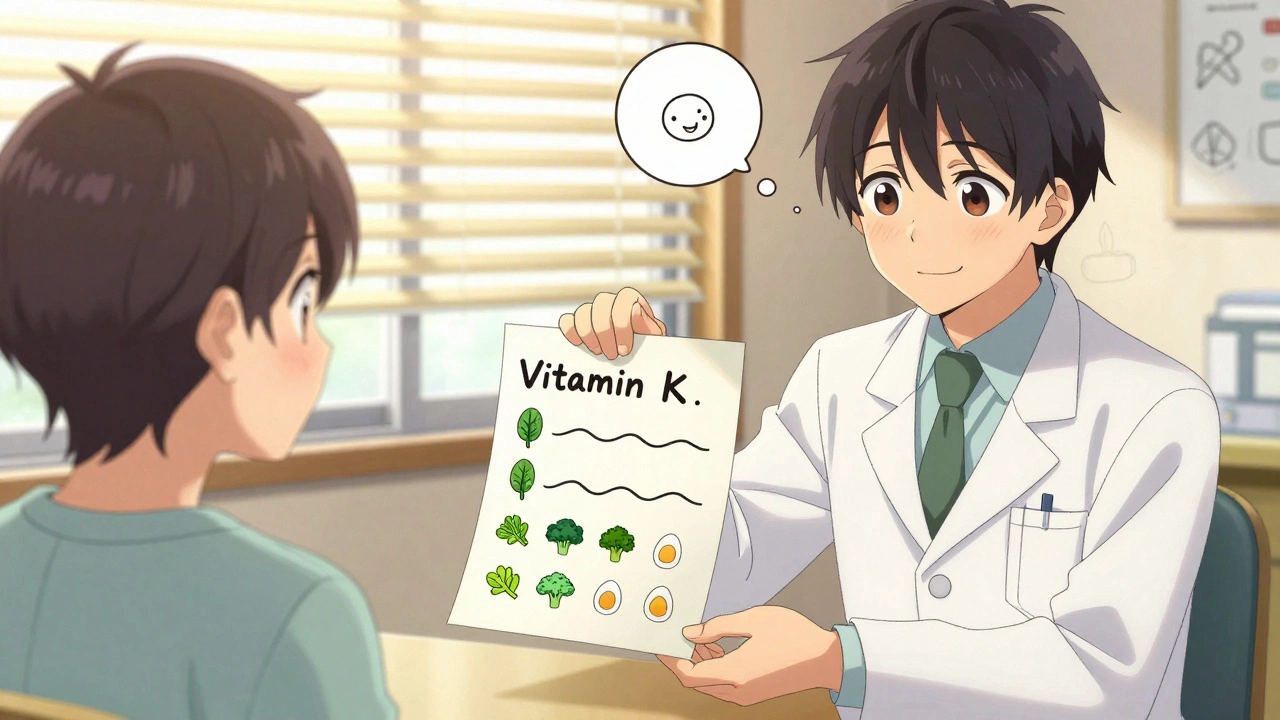
At Mayo Clinic, patients who got one-on-one counseling from anticoagulation pharmacists hit an 82% time in therapeutic range. Those who didn’t? Only 63%. The difference? Personalized, practical advice-not fear.
You don’t need to weigh every spinach leaf. Here’s how to make it simple:
One meal plan example that hits around 120 mcg:
That’s 232 mcg total for the day. But you don’t need that much every day. Spread it out. Eat 100 mcg on Monday, 110 on Wednesday, 95 on Friday. That’s consistency.
Don’t start taking vitamin K pills unless your doctor or pharmacist says so. Some multivitamins, herbal supplements, or even green powders contain hidden vitamin K. Even green tea can affect your INR if you suddenly drink 5 cups a day.
Antibiotics can also mess with vitamin K. That’s because your gut bacteria make some of it. If you’re on antibiotics, your vitamin K levels can drop-and your INR can rise. Always tell your pharmacist if you’re starting a new medicine.
And never change your warfarin dose on your own. Even if your INR is high, don’t skip your pill. Your doctor adjusts the dose based on trends-not one number.
Not everyone responds the same way. Some people have genetic variants in VKORC1 or CYP2C9 genes that make them super sensitive to vitamin K. If you’re one of them, even small changes can throw off your INR. Studies show these patients need tighter control-within ±10% variation, not ±20%.
Right now, genetic testing isn’t routine. But if you’ve had wild INR swings despite eating consistently, ask your anticoagulation clinic if testing is an option. The GIFT trial, run by the NIH, is still collecting data, but early results suggest personalized vitamin K targets could boost time in range by 15 percentage points.
Traveling doesn’t mean giving up control. Pack your measuring cup. Look up vitamin K values for common restaurant dishes. Ask for salad dressing on the side-some oils (like soybean or canola) are high in vitamin K. Stick to your routine as much as possible. If you’re eating sushi for a week, that’s fine-as long as you’re not suddenly adding seaweed salad every day.
When in doubt, eat what you normally eat. Don’t try new superfoods. No kale smoothies on vacation unless that’s your regular thing.
Warfarin isn’t about fear. It’s about rhythm. Your body doesn’t care if you eat spinach or broccoli. It cares if you eat about the same amount every week. The goal isn’t to become a nutritionist. It’s to become predictable.
Most people who stick to a steady vitamin K intake see their INR stabilize within 4-6 weeks. Their emergency visits drop. Their anxiety fades. Their life gets back to normal.
You can still eat greens. You can still enjoy meals with family. You just need to make vitamin K part of your routine-not a surprise.
Yes, you can-and you should, if you eat it regularly. The key isn’t avoiding spinach, but eating about the same amount each week. If you normally eat one cup of spinach twice a week, keep doing that. Don’t suddenly eat three cups one day and none the next. Consistency is what keeps your INR stable.
Eating a lot of vitamin K in one meal can lower your INR, making your blood clot more easily. That increases your risk of stroke or clotting. But it’s not dangerous if it’s occasional. The real problem is inconsistency. If you eat a huge amount one day and then none for days after, your INR swings wildly. That’s what puts you at risk-not the amount, but the change.
Only if your doctor or anticoagulation pharmacist recommends it. Some patients with unstable INRs benefit from a daily 150 mcg supplement-but only under supervision. Self-prescribing can make your INR harder to control. Never start supplements without talking to your care team.
Yes. Heavy drinking (more than 3 drinks a day) can increase your INR and raise bleeding risk. Even moderate drinking can interfere with how your liver processes warfarin. If you drink, keep it consistent-don’t binge one weekend and go dry the next. Same rule applies: steady intake, steady INR.
When you first start warfarin, you’ll check weekly. Once your INR is stable, it might drop to every 2-4 weeks. But if your diet changes-like suddenly eating more greens or starting a new supplement-you should check sooner. Always tell your provider about dietary changes before your next test.
Yes, and many patients find them helpful. Apps like Warframate include databases for over 1,200 foods with vitamin K content pulled from USDA data. They let you log meals and see your weekly average. But don’t rely on them alone-pair them with your INR results and your provider’s advice.
Don’t panic. Just get back to your normal routine. If you usually eat greens twice a week and missed two weeks, resume your normal amount. Don’t double up. If you’re unsure, call your anticoagulation clinic. They can advise whether you need an INR check sooner.
Managing warfarin isn’t about perfect food choices. It’s about predictable ones. You don’t have to be a nutrition expert. You just have to be consistent.

Shannara Jenkins
2 12 25 / 14:05 PMI used to freak out every time I ate a salad, but this post changed everything. Now I just eat my spinach on Tuesdays and Thursdays like clockwork-no stress, no guesswork. My INR hasn’t been out of range in 6 months. You don’t have to be perfect, just predictable. 🌿
Elizabeth Grace
2 12 25 / 21:55 PMOMG I cried reading this. I thought I was doomed to eat boring food forever. Turns out I just needed to stop being a mess about it. My husband makes me a green smoothie every other day now and I actually look forward to it. Thank you for not making me feel guilty.
Steve Enck
3 12 25 / 21:23 PMWhile the premise of dietary consistency is empirically sound, the reductionist framing of vitamin K as a mere 'thermostat' ignores the epistemological dissonance inherent in quantifying biological rhythms through arbitrary metric units. The INR, as a logarithmic construct, is itself a proxy for an unmeasurable homeostatic equilibrium, and to ascribe causality to dietary intake alone is to commit the ecological fallacy. One must interrogate the ontological underpinnings of anticoagulant management before prescribing culinary routines as panaceas.
Jay Everett
5 12 25 / 12:45 PMYESSSS this is the vibe I’ve been screaming into the void for years! 🙌 It’s not about being a kale monk-it’s about being a consistent human. I started doing 1 cup of spinach in my eggs every Monday/Wednesday/Friday and my doc actually smiled at my last visit. Like, a real smile. Not the 'you’re a walking time bomb' grimace. Also, Warframate app is a godsend. No, I’m not sponsored. I just love my blood not clotting. 💪🥗
मनोज कुमार
6 12 25 / 19:31 PMVitamin K intake variability correlates with INR instability per multiple studies. No need for emotional narratives. Just track intake. Use USDA database. Maintain ±20% daily. Done.
Joel Deang
7 12 25 / 19:35 PMbro i was eating kale smoothies every day and thought i was being so healthy 😭 then my inr spiked to 5.2 and i almost had to go to the er. now i eat like 1/2 cup of spinach 3x a week and its chill. also i spelled vitamin wrong like 5 times in this comment oops
dave nevogt
8 12 25 / 17:34 PMThere’s something deeply poetic about the idea that our bodies crave rhythm more than perfection. Warfarin doesn’t punish indulgence-it punishes unpredictability. The spinach isn’t the enemy; chaos is. We live in a world that glorifies extremes-fast food, detoxes, intermittent fasting-but here, the radical act is simply showing up the same way, day after day. It’s not about control. It’s about surrendering to the quiet science of repetition. I didn’t know I needed to hear that until now.
Arun kumar
10 12 25 / 13:47 PMthis is so true man i was eating greens random days then i start to eat same amount every tuesday and thursday and my inr stable now. no more panic. just chill. thanks for sharing
Zed theMartian
11 12 25 / 13:41 PMHow quaint. You’ve turned anticoagulation therapy into a wellness influencer’s checklist. ‘Eat your spinach like a ritual.’ How poetic. Meanwhile, people in countries without access to kale are dying from clots because their diets are ‘inconsistent’ by your standards. This isn’t mindfulness-it’s medical colonialism dressed in organic produce.
Ella van Rij
12 12 25 / 01:26 AMOh wow. So the solution to a complex pharmacological balance is… eating salad on Tuesdays? How revolutionary. I’m sure the FDA is just sitting on their hands waiting for a Reddit post to update their guidelines. 🙄 At least your ‘meal plan’ includes 232 mcg of vitamin K-clearly the only correct number, not the 150 mcg the study actually used. I’m impressed by your dedication to… pretending you’re a nutritionist.