
Think about the last time you had a sore knee, a stiff neck, or nerve pain from shingles. You probably reached for a pill. But what if you could treat that pain right where it hurts-without swallowing anything? That’s the promise of topical analgesics: gels, patches, and creams applied directly to the skin to block pain at its source.
Unlike oral painkillers that travel through your bloodstream and affect your whole body, these products work locally. They barely enter your system. That means fewer stomach issues, less strain on your liver or kidneys, and no risk of addiction like with opioids. For older adults, people on multiple medications, or those with sensitive stomachs, this isn’t just convenient-it’s life-changing.
Three main types dominate the market: lidocaine patches, capsaicin treatments, and NSAID gels. Each works in a completely different way. Knowing how they differ helps you pick the right one for your pain-and avoid wasting money on something that won’t help.
Lidocaine is a local anesthetic you’ve probably heard of from dentists. But in patch form, it’s used for long-lasting nerve pain, especially postherpetic neuralgia-the burning, stabbing pain that lingers after shingles.
The 5% lidocaine patch (sold as Lidoderm®) is applied directly over the painful area. It doesn’t heal the nerve damage, but it blocks the signals that make you feel pain. How? It stops sodium channels in nerve endings from firing. No signal, no pain.
Studies show it works best for localized pain. If your pain is spread out or deep in a joint, it won’t help much. But for a small patch of skin that feels like it’s on fire, this patch can cut pain by half. The key is timing: you wear it for 12 hours, then take it off for 12. You can use up to three patches a day, but no more. Overuse won’t make it work better-it just increases the chance of skin redness or itching.
One big plus? Systemic absorption is tiny. After 12 hours, your blood lidocaine levels are about 10% of what’s needed to cause heart problems. That’s why it’s safe for people with heart conditions who can’t take other pain meds.
Capsaicin comes from chili peppers. Yes, the same thing that makes your mouth burn. But applied to the skin in high doses, it does something surprising: it makes pain go away.
Here’s how it works. First, capsaicin activates TRPV1 receptors-tiny sensors on nerve endings that normally respond to heat. This triggers a burning sensation. It’s intense. Many people quit after the first application because it feels like a bad sunburn.
But here’s the twist: after that initial burn, the nerves get tired. They stop sending pain signals. This is called “defunctionalization.” It’s not temporary numbness-it’s a reset. One 8% capsaicin patch (Qutenza®), applied by a doctor, can give relief for up to three months.
It’s not for everyone. The pain during application is real. About 30-50% of people stop using it because of the discomfort. But for those who stick with it, results can be dramatic. One patient on Reddit said their shingles pain dropped from 8/10 to 3/10 after one treatment. That’s not a placebo-it’s science.
Important: never use capsaicin near your eyes, mouth, or genitals. Wash your hands right after applying. And don’t use the OTC version (0.025-0.1%) for serious nerve pain. It’s too weak. Only the 8% patch has proven results.

If your pain comes from swelling-like osteoarthritis in your knee or a sprained ankle-NSAID gels are your best bet. Diclofenac (Voltaren®), ibuprofen, and ketoprofen gels work by blocking COX enzymes right where the inflammation is.
Here’s the magic: these gels deliver 10 to 100 times more drug to the joint than what ends up in your blood. That means they reduce swelling and pain locally, without the stomach ulcers or high blood pressure risks you get from pills.
For knee osteoarthritis, studies show about 60% of users get significant pain relief in four weeks. For hips? Only 20%. That’s because the hip is deep under muscle and fat. The gel can’t reach far enough. So these gels work best on joints close to the surface.
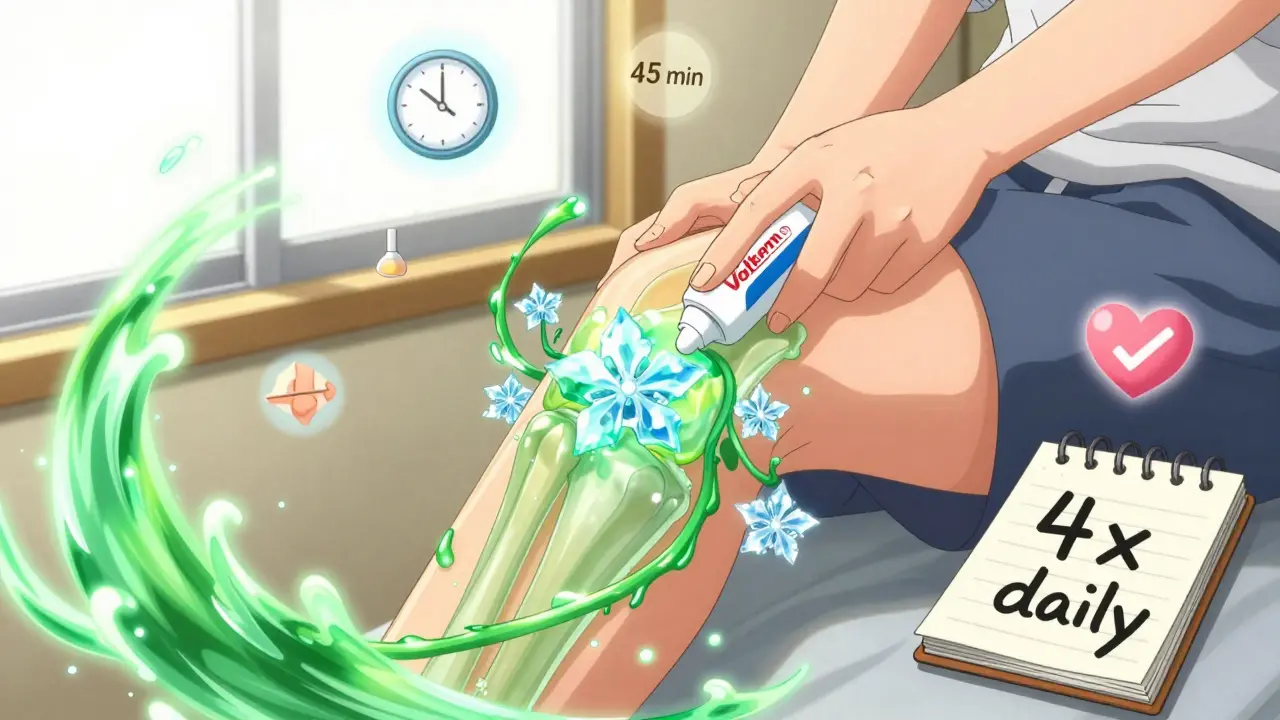
Apply it four times a day, about 2-4 inches of gel per application. Rub it in gently. Don’t wash your hands right away if you’re treating your hands. And never apply it to broken skin. A 2019 survey of 250 chronic pain patients found 72% preferred gels over pills because they didn’t get nauseous or bloated.
But there’s a catch: it takes time. Most people don’t feel relief until 45 minutes after application. And if you don’t use enough, it won’t work. Sixty percent of first-time users apply too little. Follow the ribbon guideline. And don’t expect miracles for back pain or deep muscle aches.
| Feature | Lidocaine Patch | Capsaicin Patch (8%) | NSAID Gel (e.g., Voltaren) |
|---|---|---|---|
| Best for | Neuropathic pain (e.g., shingles) | Chronic nerve pain (e.g., postherpetic neuralgia) | Inflammatory pain (e.g., knee osteoarthritis) |
| How it works | Blocks nerve signals | Depletes pain signals after initial burn | Reduces inflammation at the site |
| Onset of relief | 1-2 hours | Days to weeks (after application) | 45 minutes |
| Duration of effect | 12 hours per patch | Up to 3 months after one treatment | 4-6 hours per application |
| Application frequency | Up to 3 patches/day, 12 hours on/off | Once every 3 months (clinic only) | 4 times daily |
| Common side effects | Redness, itching at site | Burning (30-50% quit), skin irritation | Redness, dryness, mild rash |
| NNT for pain relief | 6.7 (postherpetic neuralgia) | 4.4 (postherpetic neuralgia) | 2.7 (acute sprains) |
Let’s say you’re 68 and your knees ache every morning. You take a daily aspirin for your heart and a statin. You don’t want another pill that might hurt your stomach. NSAID gel is your go-to. Apply Voltaren to each knee four times a day. You’ll likely feel better in a few weeks, with no gut issues.
Or maybe you had shingles last year, and now your side still stings like it’s on fire. No oral meds help. You’ve tried gabapentin but got dizzy. Lidocaine patch is FDA-approved for this. Put one on the painful area for 12 hours, then remove. Repeat as needed. It won’t cure the nerve damage, but it lets you sleep again.
What if you’ve tried everything for your chronic nerve pain and nothing works? You’re willing to endure a little pain for long-term relief. Your doctor applies an 8% capsaicin patch. It burns for 30 minutes. You cry. But three months later, your pain is 70% lower. No pills. No side effects. Worth it.
And if your pain is in your lower back, deep in your hip, or all over? These topical options won’t help much. They only work where the skin is the barrier-about 5-10 mm deep. Anything deeper needs oral meds, physical therapy, or injections.
Even the best product fails if used wrong. Here’s what most people get wrong:
Scientists are working on better ways to get drugs through the skin. New nanoemulsion gels are already showing up in trials-they deliver 2.3 times more diclofenac into the joint than old formulas, without raising blood levels. That means stronger relief with fewer side effects.
There’s also research into resiniferatoxin (RTX), a super-potent cousin of capsaicin. It could reset pain nerves even longer. But right now, it can’t get through the skin well enough. That’s the next hurdle.
As opioid use drops and aging populations grow, topical analgesics are becoming the first line of defense. The American Pain Society now recommends them before oral NSAIDs for joint pain. And with global sales expected to hit $8.7 billion by 2028, this isn’t a trend-it’s the new standard.
Yes, you can use them together, but not on the exact same spot. Lidocaine patches numb the nerves; NSAID gels reduce inflammation. They work differently, so combining them can give better overall relief. Just apply them to different areas of the painful zone, or use one in the morning and the other at night. Always check with your doctor if you’re unsure.
Only if the pain is close to the surface-like muscle strains near the skin. For deep back pain from a herniated disc or spinal arthritis, topical gels won’t reach far enough. They only penetrate 5-10 mm into the skin. For deeper pain, oral meds, physical therapy, or injections are more effective.
Yes. Unlike oral NSAIDs, the 8% capsaicin patch causes almost no systemic absorption. Plasma levels are so low (0.07 ng/mL) that they don’t affect blood pressure. The only risk is the initial burning sensation, which can raise heart rate temporarily. But this passes within an hour. Always have your blood pressure checked before the procedure if you have severe heart issues.
Most people start to feel relief about 45 minutes after applying Voltaren gel. Peak pain relief usually happens around 1.5 hours after application. You’ll need to use it four times a day for consistent results. Don’t expect overnight relief-it takes several days to a week for the full anti-inflammatory effect to build up.
Lidocaine patches are generally considered safe in pregnancy because so little enters the bloodstream. NSAID gels should be avoided after 20 weeks of pregnancy due to potential effects on fetal circulation. Capsaicin hasn’t been studied well in pregnancy, so it’s usually not recommended. Always talk to your OB-GYN before using any topical pain product while pregnant.
For NSAID gels, yes-OTC diclofenac (1%) is just as effective as the prescription version. But for capsaicin, no. OTC creams have only 0.025-0.1% capsaicin. That’s too low to affect nerve pain. Only the 8% prescription patch works for conditions like postherpetic neuralgia. Lidocaine patches are only available by prescription because of dosing limits and safety rules.

calanha nevin
31 01 26 / 10:34 AMLidocaine patches saved my life after shingles. I tried everything else. Nothing worked. This one? I could sleep again. No side effects. Just quiet.
Use three patches max. Don't overdo it. Skin gets red. That's it.
Lisa McCluskey
31 01 26 / 22:30 PMI used the 8% capsaicin patch last year. It burned like hell for 20 minutes. I cried. My doctor laughed. But three months later? My nerve pain was gone. No pills. No dizziness. Worth every second of agony.
owori patrick
2 02 26 / 09:14 AMIn Nigeria, we use ginger and pepper paste for joint pain. Not science, but it works. I tried Voltaren gel after reading this. Same result. Maybe the heat triggers something deeper than chemistry.
Claire Wiltshire
3 02 26 / 09:42 AMIt's important to note that OTC capsaicin creams are ineffective for neuropathic pain. The concentration is too low. Only the 8% prescription patch has clinical evidence. Many patients waste money on drugstore products that don't penetrate deeply enough. Always check the label. 0.025% won't touch postherpetic neuralgia.
April Allen
4 02 26 / 01:44 AMThe mechanistic divergence here is fascinating. Lidocaine modulates voltage-gated sodium channels, inducing a transient conduction block. Capsaicin triggers TRPV1-mediated defunctionalization - a neuroplastic reset of nociceptor terminals. NSAIDs inhibit COX-2 isoforms locally, reducing prostaglandin E2 synthesis at the site of inflammation. These are not interchangeable modalities. They operate on distinct neurobiological axes. Misapplication stems from conflating mechanism with outcome. Pain is not monolithic. Neither should be treatment.
Kathleen Riley
5 02 26 / 04:37 AMI find it deeply concerning that the medical establishment promotes topical agents as a 'first line' without addressing the root cause. Pain is a symptom. You're not treating inflammation or nerve damage. You're masking it. This is pharmaceutical band-aid culture. We need to interrogate why the body is signaling distress - not just silence the signal.
Amy Insalaco
5 02 26 / 21:05 PMLet’s be real - this whole topical analgesic movement is just Big Pharma’s way of repackaging old drugs with new labels and premium pricing. Lidocaine patches? Been around since the 70s. Capsaicin? Used in folk medicine for centuries. NSAID gels? Just oral NSAIDs with a slower absorption curve. The NNTs are barely better than placebo in many cases. The real profit driver is the convenience narrative. Patients want magic. They get $60 patches that work slightly better than a heating pad. And we call it innovation.
Katie and Nathan Milburn
6 02 26 / 14:38 PMI’ve been using Voltaren for my knee for six months. It helps. Not magic. But better than ibuprofen. I don’t get the stomach cramps. I don’t feel foggy. I just rub it on. Four times a day. I forget half the time. Still works. No drama.
Beth Beltway
8 02 26 / 11:10 AMYou people are naive. The FDA approved these because they’re profitable, not because they’re effective. Lidocaine patches? They barely reduce pain beyond placebo in blinded trials. Capsaicin? Only works if you’re willing to suffer through the burn - and even then, relapse is common. NSAID gels? The systemic absorption is low, yes, but the local irritation causes more dermatitis than benefit. This is pseudoscience dressed up as evidence. And you’re all drinking the Kool-Aid because it sounds safer. Safety without efficacy is just a placebo with a higher price tag.