
When a new drug hits the market, the clock starts ticking-not just on its patent, but on how long the company can keep competitors out. Most people think patents are the only thing blocking generics. They’re not. In reality, the real monopoly often begins after the patent expires. That’s where market exclusivity extensions come in-legal tools built into drug approval systems that let companies hold onto high prices long after the original patent runs out.
Patents Are Just the Beginning
A typical drug patent lasts 20 years from the date it’s filed. But here’s the catch: most of that time passes before the drug even reaches patients. Clinical trials take 7-10 years. The FDA review adds another 1-3. By the time the drug is approved, you’ve already used up half the patent life. That’s why Congress created patent term extensions in 1984 under the Hatch-Waxman Act. The idea was simple: compensate for lost time. The law lets companies add up to five years to their patent, but with a hard cap-no more than 14 years of market exclusivity after FDA approval.
But that’s not where it ends. The real game isn’t about extending the patent. It’s about stacking layers of protection on top of it.
The Five Big Regulatory Exclusivities in the U.S.
The FDA doesn’t just hand out patents. It gives out five types of market exclusivity that work independently of patents. Even if a drug has no patent left, these can still block generics.
- New Chemical Entity (NCE) exclusivity: Five years. No generic can even file an application for five years after approval. For the first four, they can’t even use the brand’s data to prove safety.
- Orphan Drug exclusivity: Seven years. For drugs treating rare diseases (fewer than 200,000 U.S. patients). Even if another company makes the exact same drug for the same disease, they can’t get approved during this time.
- New Clinical Investigation exclusivity: Three years. For new uses of existing drugs. Not for new formulations. The FDA now requires proof the new use actually helps patients more than just prescribing the old drug off-label.
- Pediatric exclusivity: Six months added to any existing exclusivity. Companies get this by completing FDA-requested studies on children. It’s not a standalone period-it’s a bonus tacked onto the end of everything else.
- Patent challenge exclusivity: 180 days. The first generic company to challenge a patent gets exclusive rights to sell their version before anyone else. This is a carrot to get generics to sue.
These aren’t optional. They’re automatic. File the right paperwork, complete the right studies, and the clock starts ticking-no matter what the patent says.
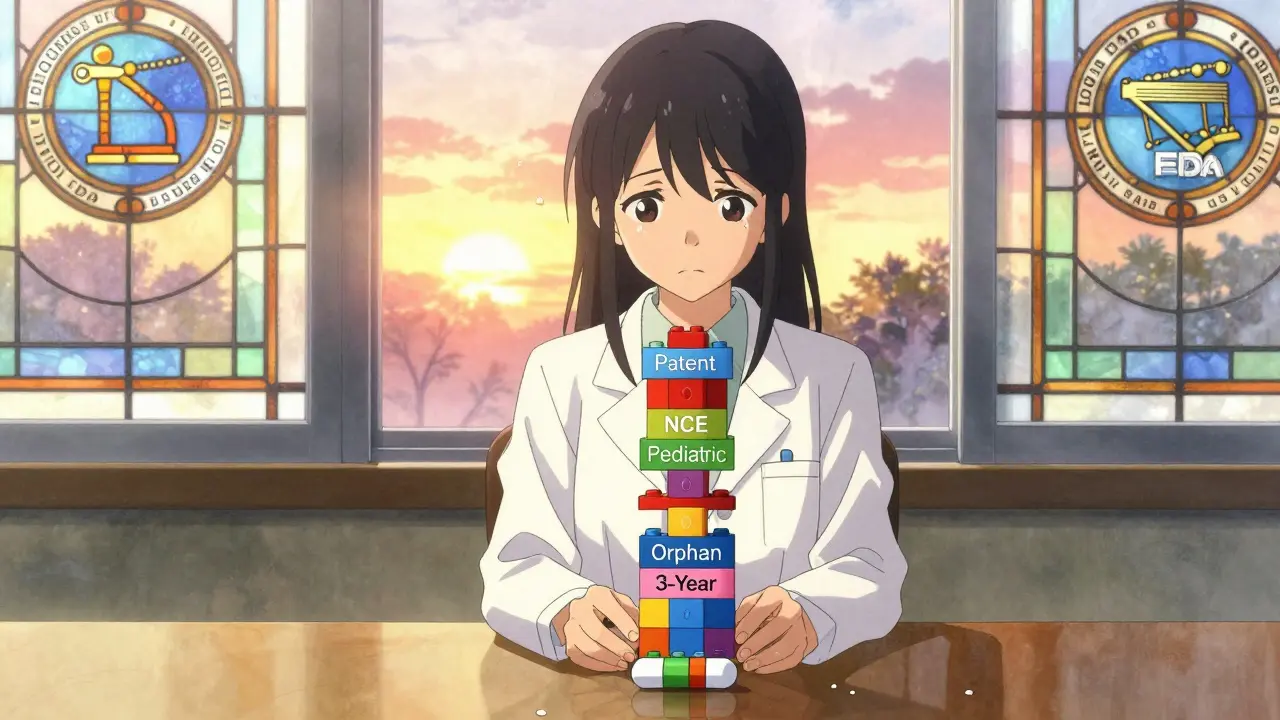
How Companies Stack Them Like LEGO Blocks
The most profitable drugs don’t rely on one exclusivity. They stack them. Take a drug like imatinib (Gleevec), used for leukemia. It had a core patent. Then it got NCE exclusivity. Then it got pediatric exclusivity. Then it got a new indication for another cancer, triggering three-year exclusivity. Then it got orphan status for a rare subtype. Each layer adds time. And each layer blocks generics.
One drug, tazarotene, accumulated 48 secondary patents after its core patent. These weren’t for new molecules-they were for new delivery methods, new dosing schedules, even new packaging. Each one delayed a generic. This is called a “patent thicket.” It’s not innovation. It’s legal obstruction.
The result? The average new drug keeps its monopoly for 12.7 years in 2018. By 2028, it’s projected to hit 16.3 years. That’s more than a decade of no competition. For a drug that costs $150,000 a year, that’s billions in extra revenue.
Europe Does It Differently
The EU doesn’t use patent term extensions the same way. Instead, it has Supplemental Protection Certificates (SPCs). These can extend protection up to 15 years after market approval-slightly longer than the U.S. cap. The EU also gives orphan drug exclusivity for 10 years, extendable to 12 if the company completes pediatric studies.
But here’s the key difference: the EU separates data exclusivity from market exclusivity. Data exclusivity means generics can’t use the original company’s clinical trial data for five years. Market exclusivity means they can’t even get approved for ten years. The U.S. doesn’t make that distinction-it just blocks generics outright.
The EU is trying to fix what’s broken. In 2023, the European Commission proposed changes to SPCs to stop companies from getting extra years for tiny tweaks-like changing a pill’s color or coating. The U.S. hasn’t made similar moves yet.
Why This Matters to Patients and Payers
For patients, this means higher prices. For insurers and government programs, it means billions in wasted spending. A 2023 JAMA Health Forum study looked at just four drugs: bimatoprost, celecoxib, glatiramer, and imatinib. In the two years after generics *should* have entered, they didn’t. Why? Because exclusivity extensions blocked them. The result? $3.5 billion in extra spending.
That money doesn’t go to research. It goes to profits. The average cost to develop a new drug is $2.3 billion. But the average revenue from a blockbuster drug in its first five years is $10 billion. That’s not a small return. It’s a windfall.
Critics call this “evergreening.” The industry calls it “incentivizing innovation.” But when a company files 48 patents on the same molecule just to delay generics, is that innovation-or just a legal loophole?
How Generics Fight Back
Generic makers aren’t sitting still. They challenge patents. They file lawsuits. They use the 180-day exclusivity window to get a head start. But it’s expensive. A single patent lawsuit can cost $5 million. Only the biggest generics companies can afford it.
Some use “product hopping”-launching a slightly changed version of the drug right before the patent expires. The original gets discontinued. Patients are pushed to the new version. Generics can’t copy it because it’s not the same drug. Teva reported this tactic delayed generics for 17% of their target drugs.
The FTC is watching. In 2023, they filed a legal brief arguing that product hopping violates antitrust laws. But courts move slowly. Meanwhile, companies keep stacking exclusivities.
Who Benefits? Who Gets Left Behind?
Orphan drugs are the exception that proves the rule. For rare diseases, there’s no market incentive to develop treatments. Exclusivity gives companies a reason to try. For patients with conditions affecting fewer than 200,000 people, these protections are lifelines. The FDA approved over 1,000 orphan drugs in 2022-up from 200 in 2010.
But for common conditions-diabetes, high blood pressure, arthritis-the same tools are used to extend monopolies on drugs that could be made cheaply. The result? A system that works great for rare diseases but distorts the entire market.
The real winners? Big pharma. The real losers? Patients paying out of pocket, Medicaid, Medicare, and private insurers.
What’s Next?
Regulators are starting to push back. The FDA tightened rules for three-year exclusivity in 2023, demanding stronger proof of clinical benefit. The European Medicines Agency is speeding up pediatric review to reduce delays. But the core problem remains: the system was designed in 1984 for a simpler world.
Today, drugs are complex. Patents are weaponized. Exclusivities are stacked. The result? A system that rewards legal strategy more than medical breakthroughs.
The question isn’t whether exclusivity should exist. It’s whether we’re using it to encourage real innovation-or just to delay the inevitable.
How long can a drug stay on the market without competition?
On average, new drugs enjoy 12-16 years of market exclusivity after FDA approval, thanks to a mix of patents, regulatory exclusivities, and strategic filings. Some drugs, especially those with multiple orphan designations and pediatric extensions, can block generics for over 20 years.
Can a drug have market exclusivity without a patent?
Yes. Regulatory exclusivities like orphan drug status or pediatric exclusivity don’t require a patent. A drug can be completely unpatented but still protected from generics for 7-12 years if it qualifies for orphan status or completes pediatric studies.
What’s the difference between patent extension and regulatory exclusivity?
A patent extension (like PTE in the U.S.) adds time to the patent itself and is granted by the patent office. Regulatory exclusivity is granted by the FDA and blocks generics from entering the market regardless of patent status. One is about intellectual property; the other is about data and market access.
Why do companies file so many secondary patents?
Secondary patents cover minor changes-new dosages, delivery methods, formulations, or uses. They’re not always innovative, but they’re legally effective. Filing dozens of them creates a “patent thicket” that makes it too expensive and risky for generics to challenge them all.
Do market exclusivity extensions help innovation?
They help for rare diseases where there’s no market incentive. For common conditions, evidence suggests they mostly delay competition without driving new breakthroughs. Studies show most extensions are applied to drugs with already high profits, not to risky, high-cost projects.

Brendan F. Cochran
5 01 26 / 03:48 AMSo let me get this straight - we’re letting Big Pharma lock down drugs for 20 years like they’re the fucking Pope of pills? Meanwhile, my insulin costs more than my rent. This ain’t innovation, it’s corporate robbery with a law degree.
jigisha Patel
5 01 26 / 18:17 PMWhile the structural mechanisms described are accurate, the conflation of regulatory exclusivity with patent law reflects a fundamental misunderstanding of the FDA’s statutory mandate under 21 U.S.C. § 355. Exclusivity is not a loophole-it is a congressionally authorized incentive structure designed to balance innovation and access. The 12.7-year average cited is misleading without normalization for drug class, indication, and R&D cost variance.
Mandy Kowitz
7 01 26 / 16:41 PMOh wow. So the real villain isn’t the greedy pharma execs… it’s the *lawmakers* who wrote the rules? Shocking. Next you’ll tell me oxygen is patented too.
Justin Lowans
8 01 26 / 20:13 PMThis is one of the most lucid breakdowns of pharmaceutical policy I’ve seen in years. The stacking of exclusivities is like a legal Jenga tower - pull one block and the whole structure might collapse. What’s needed isn’t outrage, but recalibration: targeted reforms that preserve incentives for rare disease drugs while dismantling the gerrymandered protections on common medications. We can fix this - if we choose to.
Cassie Tynan
9 01 26 / 11:01 AMThey call it innovation. I call it playing Monopoly with people’s lives. The FDA isn’t a health agency - it’s a corporate vending machine that dispenses monopoly licenses. And we’re the ones feeding it quarters.
Chris Cantey
10 01 26 / 18:05 PMThe system is rigged. The patents, the exclusivities, the lawsuits - it’s all designed to keep the price high and the truth buried. They don’t care if you die waiting for a generic. They just want your insurance number.
Abhishek Mondal
11 01 26 / 16:54 PMOne must consider, however, the epistemological implications of conflating market exclusivity with innovation - a fallacy rooted in the reification of capital as merit. The regulatory architecture, while ostensibly designed to incentivize R&D, paradoxically rewards legalistic manipulation over therapeutic advancement - a dialectical contradiction inherent in late-stage capitalist healthcare systems. One wonders whether the FDA, as an institution, is complicit in the ontological erasure of patient agency.
Oluwapelumi Yakubu
12 01 26 / 12:34 PMMan, this is wild! In Nigeria, we can’t even get the original drug sometimes - let alone generics. But here, they’re stacking exclusivities like Pokémon cards? The whole thing’s a circus. Pharma’s not selling medicine - they’re selling time. And we’re paying for every second.
Siobhan Goggin
13 01 26 / 17:16 PMThank you for breaking this down so clearly. I’ve been paying $1,200 a month for my medication and never understood why generics weren’t available. This makes sense now - and it’s infuriating. We need change.
josh plum
15 01 26 / 16:10 PMBig Pharma is working with the government to keep you sick. It’s not about profit - it’s about control. They want you dependent. They want you on the pill. They want you paying forever. This isn’t capitalism - it’s a medical dictatorship. And the FDA? They’re just the enforcers.
Ashley Viñas
16 01 26 / 20:30 PMIt’s fascinating how people act surprised by this. The system was built this way. Every single provision was lobbied for. Every delay, every extension - written by lawyers in suits who’ve never met a patient. The real crime isn’t the exclusivity - it’s that we let them get away with it.
Jason Stafford
18 01 26 / 13:38 PMThey’re not just blocking generics - they’re erasing choice. One company, one drug, one price. And if you can’t afford it? Tough. You’re not a customer - you’re a revenue stream. This isn’t healthcare. It’s a surveillance state with pills.
Ethan Purser
20 01 26 / 01:45 AMMy dad died waiting for a generic version of his heart med. They kept extending exclusivity because ‘it was a new formulation.’ It was the same damn pill in a different color. That’s not innovation. That’s cruelty dressed up as science.
Doreen Pachificus
21 01 26 / 00:18 AMSo… if a drug has no patent but still has orphan status, it’s basically immune to generics? That’s wild. I didn’t realize exclusivity could work that way. Thanks for the clarity - this stuff needs more attention.