When you walk into a pharmacy to pick up your monthly medication, you might assume the price is fixed-set by the manufacturer, the insurer, or the doctor. But here’s the truth: generic drug prices aren’t fixed at all. They’re the result of a silent, fierce battle between manufacturers-what experts call a price war. And when it works right, you save big. Like, hundreds of dollars a year big.
How Generic Drug Price Wars Actually Work
Once a brand-name drug’s patent expires, any company can make a copy. That copy is called a generic. It’s not a knockoff. It’s the exact same active ingredient, same dosage, same effectiveness. The only difference? Price. And that’s where the war starts.
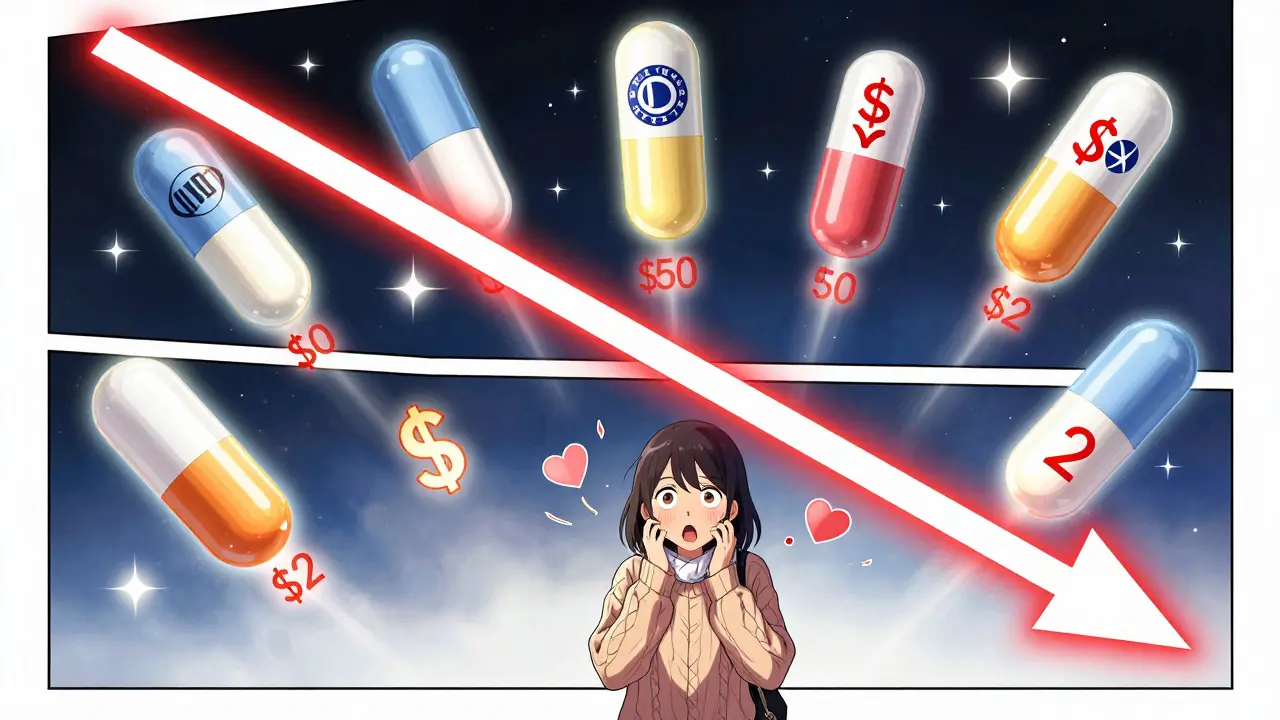
The first generic maker might charge $50 for a 30-day supply. The second comes in at $35. Then a third drops to $20. By the time six or more companies are selling the same pill, the price can plunge to under $5. According to the FDA, when six or more generic manufacturers enter the market, prices drop more than 95% compared to the original brand. That’s not a guess. That’s data from 2019, confirmed by multiple studies.
It’s simple economics: more sellers = lower prices. But here’s where it gets messy. You don’t always see those savings at the register.
Why You Might Still Pay Too Much
You’d think if a generic version of metformin costs $3 to make, you’d pay $3. But that’s not how it works. Pharmacy Benefit Managers (PBMs)-the middlemen between insurers, pharmacies, and drugmakers-control most of the pricing pipeline. And they don’t always pass savings along to you.
One trick?
Spread pricing. A PBM might tell your insurer the generic costs $20. They pay the pharmacy $8. You pay a $10 copay. The PBM pockets $12. You think you’re saving money because your copay is low. But you’re not seeing the real price. And if you paid cash, you might’ve paid just $5.
Another issue? Formularies. Insurers often push you toward a slightly more expensive generic because the PBM gets a bigger kickback. Even if a cheaper version exists, your insurance might not cover it. This isn’t rare. Harvard’s Dr. Ateev Mehrotra found that most of the savings from generic competition end up in the hands of PBMs-not patients.
How Many Competitors Actually Matter
Not all generics are created equal. The number of companies selling the same drug makes a huge difference:
- One generic maker? Price might be only 15-30% lower than the brand.
- Two to three makers? Around 50% off.
- Four to five makers? 80-85% off.
- Six or more? Over 95% off.
Take lisinopril, a common blood pressure pill. With one generic, you might pay $40. With four, it’s $5. With eight, it’s $2. That’s not theory-it’s what happened in real markets. The RAND Corporation found U.S. generics are priced 84% lower than brands when competition is strong.
But here’s the catch: if prices drop too low, manufacturers quit. They can’t make money. So a drug with ten makers today might have only two next year. That’s when shortages happen. In 2024, 30% of generic shortages occurred in markets with four or more competitors-because the price war drove profits to zero.
What You Can Do to Save
You don’t have to wait for regulators to fix the system. You can take control today.
Always ask for the cash price. Even if you have insurance. In 28% of cases, the cash price is lower than your copay. Why? Because PBMs charge you more than the pharmacy pays. A 30-day supply of atorvastatin might cost $12 with insurance but only $4 cash. That’s not a myth. That’s what GoodRx found across thousands of transactions.
Compare prices across pharmacies. The same generic drug can vary by 300% between Walmart, CVS, and Walgreens. Use GoodRx or SingleCare. They show real-time cash prices. No sign-up needed.
Check the AB rating. The FDA gives generics an AB rating to show they’re bioequivalent. If it says AB, it’s safe. If it says BN or something else, ask your pharmacist. Not all generics are equal in performance.
Don’t trust your insurance formulary blindly. Just because your plan covers a drug doesn’t mean it’s the cheapest. Ask your pharmacist: “Is there a lower-cost generic I can switch to?”
When the System Fails You
Some drugs don’t have enough competition. Insulin glargine biosimilars, for example, still cost hundreds of dollars because only a few companies make them. EpiPens? Even after generics arrived, prices stayed high because of legal barriers and slow approvals.
And then there’s the gag rule-gone now, but its legacy remains. Until 2018, pharmacists couldn’t tell you the cash price was cheaper than your copay. Many still don’t. You have to ask.
Consumer Reports found 42% of people didn’t know they could pay less by skipping insurance for generics. That’s not your fault. It’s a broken system.

The Bigger Picture
The U.S. spends $71 billion a year on generic drugs. That’s 90% of all prescriptions-but only 23% of total drug spending. Why? Because brand-name drugs are still insanely expensive. Generics are the only thing keeping the system from collapsing.
But consolidation is a problem. Five companies-Teva, Viatris, Sandoz, Amneal, and Aurobindo-control over 60% of the generic market. That’s not competition. That’s an oligopoly. And it’s why prices don’t always drop as fast as they should.
The FDA approved over 1,000 generic drugs in 2023-up from 748 in 2022. That’s good news. More drugs entering the market means more price wars. But without transparency, those savings won’t reach you.
Final Take: Your Savings Are in Your Hands
Generic price wars aren’t magic. They don’t automatically lower your bill. They create the *potential* for savings. But you have to unlock it.
If you take a daily pill-blood pressure, cholesterol, diabetes, thyroid-spend 10 minutes every few months checking prices. Use GoodRx. Ask your pharmacist. Switch to cash if it’s cheaper. That’s not being cheap. That’s being smart.
The system is rigged. But you’re not powerless. Every dollar you save on a generic is a dollar you didn’t have to pay to a middleman. And that’s the real win of a price war.
Why are generic drugs so much cheaper than brand-name drugs?
Generic drugs cost less because they don’t need to repeat expensive clinical trials. The original brand paid millions to prove the drug is safe and effective. Generic manufacturers only need to prove their version works the same way. That cuts development costs by 90%. They also don’t spend money on advertising. The savings are passed on-but not always to you, because middlemen like PBMs often take a cut.
Can I trust generic drugs to work as well as brand-name ones?
Yes. The FDA requires generics to have the same active ingredient, strength, dosage form, and route of administration as the brand. They must also be bioequivalent-meaning they deliver the same amount of medicine into your bloodstream at the same rate. Look for the AB rating on the label. If it’s AB, it’s approved as interchangeable. There are rare cases where people react differently to fillers or coatings, but that’s uncommon.
Why does the same generic drug cost different prices at different pharmacies?
It’s because of how PBMs negotiate with pharmacies. Each pharmacy has a different contract with your insurer or PBM. Some get paid more per prescription, others less. Cash prices are set by the pharmacy directly, so they can be much lower. That’s why you can pay $2 at Walmart and $20 at CVS for the same pill. Always compare.
Should I always use my insurance for generic prescriptions?
Not always. In many cases, paying cash is cheaper than using your insurance copay. That’s because PBMs often set copays higher than the actual cost of the drug. If you’re on a high-deductible plan or pay a fixed copay, check the cash price first. You might save 50% or more.
What should I do if my generic drug suddenly gets more expensive?
Check if the manufacturer changed or if competition dropped. If your drug was priced at $5 and now costs $25, it’s likely only one or two companies are making it now. Ask your pharmacist for alternatives. Use GoodRx to find other pharmacies selling the same drug cheaper. Sometimes switching to a different generic brand-even if it’s the same active ingredient-can save you money.
Are there any generic drugs that don’t have price wars?
Yes. Some drugs are hard to make, have few manufacturers, or are protected by legal barriers. Examples include certain insulin products, epinephrine auto-injectors, and some injectable drugs. These often have only one or two generic options, so prices stay high. The FDA is working to speed up approvals for these, but it takes time.

Jessica Salgado
17 12 25 / 01:49 AMI had no idea my $12 copay for metformin was actually $4 cash. I just started using GoodRx and switched last month-my monthly drug bill dropped by $200. I feel like I’ve been robbed for years and didn’t even know it.
Why does no one tell you this? Pharmacists act like they’re forbidden to mention it. I had to ask three times before the guy at CVS whispered, ‘It’s $3.79 if you pay cash.’ I almost cried.
Thank you for writing this. I’m telling everyone I know.
Kent Peterson
17 12 25 / 06:31 AMSo... you’re telling me the government didn’t fix this? Of course not. The FDA? PBMs? They’re all part of the same cartel. You think these ‘generic’ pills are cheap? They’re not. They’re just being sold at a loss to lure you in-then they raise prices on the next batch. It’s psychological pricing. They want you addicted to the illusion of savings.
And don’t even get me started on how Teva owns half the market. That’s not competition. That’s a monopoly with a fake name.
Also, GoodRx? That’s a data harvesting scheme. They sell your prescription habits to insurers. You’re the product, dummy.
Evelyn Vélez Mejía
19 12 25 / 05:43 AMThe pharmaceutical ecosystem operates as a grotesque ballet of misaligned incentives: manufacturers, PBMs, insurers, and pharmacies each dance to their own fiscal score, while the patient-devoid of agency, blinded by opacity-is left to stumble through the wreckage of cost-efficiency.
What we call a ‘price war’ is, in truth, a silent auction where the highest bidder is not the consumer, but the intermediary with the most labyrinthine contract.
And yet, the irony is sublime: the very mechanism designed to democratize access-generic substitution-has been co-opted into a mechanism of extraction.
The FDA’s AB rating, a beacon of bioequivalence, is rendered meaningless when the same molecule, in identical dosage, costs $2.49 at one counter and $24.99 at another, with no discernible difference in pill color or capsule shell.
Perhaps what we need is not more transparency, but a redefinition of value: not the price on the receipt, but the dignity of being treated as a human being, not a revenue stream.
Until then, we are all complicit in our own exploitation-because we did not ask for the cash price.
And that, more than anything, is the tragedy.
Nishant Desae
19 12 25 / 08:44 AMHey everyone, just wanted to say this article really helped me understand why my dad’s blood pressure med went from $5 to $25 last year. I didn’t know it was because only two companies were making it anymore. I showed him how to use GoodRx and he’s been saving like 80% ever since.
Also, I’m from India and we have this thing called Jan Aushadhi where generic drugs are sold super cheap-like $0.10 for a pill. It’s amazing how simple it is when the government steps in.
Here in the US, we’re so used to overpaying that we don’t even question it. But it’s not normal. We can do better. You guys are doing the right thing by asking questions and checking cash prices. Keep it up. I’m proud of you all.
And if you’re scared to ask your pharmacist, just say ‘I’m trying to save money, can you help me?’ They’ll help. I promise.
Also, my cousin switched from brand-name insulin to a biosimilar and saved $400 a month. It’s not magic. It’s just knowing where to look.
You’re not alone. We’re all in this together. 💪
Jonathan Morris
20 12 25 / 00:48 AMThey don’t want you to know this because it exposes the entire pharmaceutical-industrial complex as a Ponzi scheme. PBMs are not middlemen-they’re thieves with corporate logos. The FDA approves generics but doesn’t regulate pricing? That’s not oversight. That’s complicity.
And GoodRx? It’s a front. They’re owned by private equity firms that profit when you switch to cash. They want you to think you’re saving, but they’re just shifting the profit from one pocket to another.
Meanwhile, the real drug manufacturers? They’re being squeezed out. When prices drop below $1 per pill, they shut down. Then you get shortages. Then they cry ‘supply chain issues’ and jack up prices again.
It’s all orchestrated. The ‘competition’ is fake. The ‘savings’ are illusions. And you? You’re the fool who thinks you’re winning the game.
Wake up.
Linda Caldwell
20 12 25 / 01:00 AMJust switched my cholesterol med to cash and saved $150/month. I’m telling my mom, my sister, my yoga instructor-everyone. This is free money. Stop letting them rip you off. You got this. 💖
Anna Giakoumakatou
21 12 25 / 20:38 PMOh, how darling. A self-help guide to surviving capitalism’s most grotesque loophole: the ‘generic’ drug. How quaint that you believe asking for the cash price is rebellion. You’re not saving money-you’re participating in a performance of economic agency, curated by a corporation that profits from your desperation.
And GoodRx? How poetic. A platform that sells your health data to insurers while whispering, ‘Here’s your $4 pill.’ You’re not a consumer. You’re a data point with a prescription.
At least the oligopolists have the decency to be transparent about their greed. You? You’re just proud you found the discount aisle in the dystopia.
CAROL MUTISO
22 12 25 / 02:29 AMCan I just say how much I appreciate this breakdown? I’ve been a pharmacy tech for 12 years and I’ve watched this exact system collapse under its own greed.
People think the ‘cheaper’ generic is always better-but sometimes the fillers change and it messes with absorption. I’ve had patients switch and get dizzy, or their thyroid levels go haywire. It’s rare, but it happens.
And yes, the cash price is often lower-but not always. I’ve seen Walmart charge $25 for a drug that CVS sells for $8. Why? Because their PBM contract is different. It’s chaos.
But here’s what I tell every patient: ‘Ask. Always ask.’ Don’t be embarrassed. Pharmacists want you to save. We just can’t always say it unless you prompt us.
Also, if your drug suddenly costs more? Don’t assume it’s your fault. It’s probably because the manufacturer dropped out. Tell your doctor. They can help you find alternatives.
You’re not being paranoid. You’re being smart. And you deserve better.
Erik J
23 12 25 / 10:01 AMInteresting. I checked my lisinopril. Cash price: $3.20. Insurance copay: $12. I didn’t know. I’ll start using GoodRx. Thanks for the info.
Also, the part about six+ manufacturers dropping prices 95%-that’s wild. Makes me wonder why we don’t have more generic makers. Probably regulatory barriers.
Still, I’m glad someone’s pointing this out. I’ll tell my brother. He’s on metformin too.
Martin Spedding
25 12 25 / 09:53 AMSo... PBMs are the real villains? Wow. Groundbreaking. Next you’ll tell me water is wet.
And GoodRx? LOL. It’s a scam. They’re owned by hedge funds. You think you’re saving? You’re just feeding the machine.
Also, ‘ask your pharmacist’-yeah right. They’re paid to push the most expensive option. They don’t care.
Just pay cash. That’s the only solution. Everyone else is lying to you.
And yes, I’m from the UK. We got NHS. You guys are doomed.
Chris Van Horn
27 12 25 / 06:32 AMLet me be perfectly clear: this entire article is a distraction. The real issue is not PBMs, not generics, not even the FDA-it’s the fact that the United States has surrendered its sovereign right to regulate pharmaceutical pricing to multinational conglomerates and Wall Street vultures.
When a nation allows private equity firms to dictate the cost of life-saving medicine, it ceases to be a democracy. It becomes a corporate fiefdom.
And you? You think checking GoodRx is activism? It’s not. It’s the equivalent of polishing your chains while your wrists bleed.
True change requires dismantling the entire system-nationalizing drug manufacturing, abolishing PBMs, and enforcing price controls with the full force of federal law.
Until then, your ‘savings’ are a placebo. A psychological Band-Aid on a gaping arterial wound.
And yes, I’ve read every study. I’ve spoken to FDA whistleblowers. I’ve seen the contracts.
You’re not saving money.
You’re surviving.
And that’s not enough.
Jessica Salgado
29 12 25 / 05:39 AMWait-I just read your comment, Jonathan. You’re right. Asking for cash prices isn’t enough. We need systemic change. But until that happens, I’m still going to use GoodRx. Because while we wait for Congress to act, my diabetes isn’t waiting. I’m not going to let perfect be the enemy of ‘I can afford to live today.’
And if that makes me a capitalist pawn? Fine. I’ll be a pawn who’s still breathing.