Ever wonder why some drugs have two names? One sounds like a science experiment-albuterol-and the other like something you’d hear in a British hospital-salbutamol? Or why omeprazole ends in ‘-prazole’ while atorvastatin ends in ‘-statin’? It’s not random. There’s a whole system behind how drugs get their generic names, and it’s designed to keep you safe.
Generic names aren’t just for doctors and pharmacists. They’re used in prescriptions, medical records, insurance forms, and drug labels. If two drugs have similar names, someone could mix them up. A patient might get the wrong dose. A nurse might give the wrong drug. That’s why these names aren’t chosen by marketing teams-they’re chosen by scientists, pharmacists, and regulators to be clear, unique, and meaningful.
When a drug company develops a new medicine, they can’t just pick any name. They submit up to six name options to the USAN Council. The council checks each one for conflicts with existing drug names, trademark issues, and even how it sounds in different dialects of English. They want to avoid names that sound like other drugs. For example, they wouldn’t approve a name that sounds too close to “hydralazine” if there’s already a “hydroxyzine” on the market.
Once USAN picks a name, it becomes the official generic name for use in the U.S. The FDA requires it on all drug labels sold here. But here’s the twist: USAN doesn’t automatically accept the international name. That’s where INN comes in.
INN names are designed to be understood by doctors in Tokyo, Toronto, and Tanzania. The WHO works with national naming bodies-including USAN-to align names as much as possible. About 95% of the time, USAN and INN match. But not always.
Take acetaminophen. In the U.S., that’s the name. Everywhere else? It’s paracetamol. Albuterol in the U.S. is salbutamol in Europe. Rifampin in the U.S. is rifampicin abroad. These aren’t typos. They’re historical differences that stuck.
These small mismatches cause real problems. There have been documented cases where international travelers got the wrong medication because their prescription used a different name. That’s why pharmacists are trained to recognize both versions.
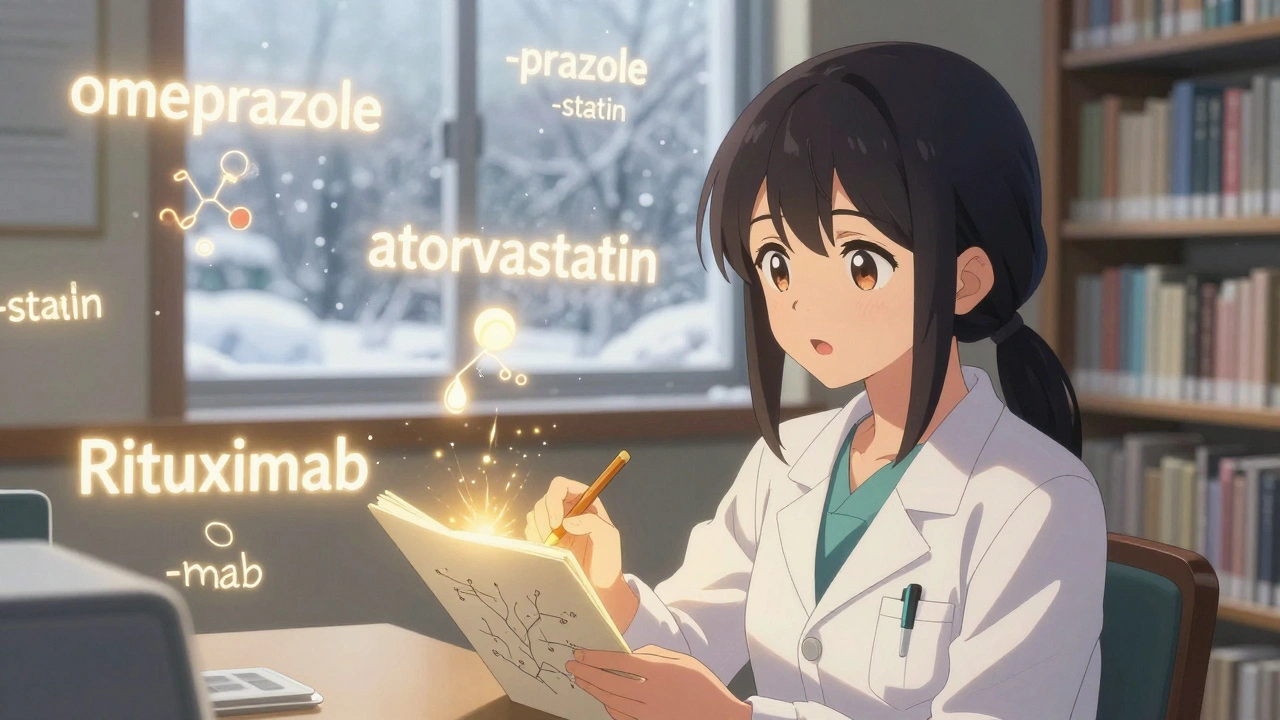
Once you know the stem, you know the class. That’s huge in emergency situations. If a patient has a reaction to a drug ending in “-mab,” a doctor immediately knows it’s an immune-targeting biologic.
There are also sub-stems for more detail. For monoclonal antibodies:
The first part of the name-the prefix-is usually made up. It doesn’t mean anything. “Ome-” in omeprazole? Just a sound that’s easy to say and remember. “Ator-” in atorvastatin? No hidden meaning. It’s there to make the name unique.
There are also prefixes that tell you about chemical structure:
This level of detail helps doctors understand subtle differences between drugs that might look identical at first glance.
Companies spend millions testing brand names. They run focus groups. They check trademarks in every country. They even test how the name sounds when spoken by someone with a thick accent.
That’s why you get names like Prozac, Viagra, or Humira. They’re not based on chemistry. They’re designed to stick in your mind. “Viagra” sounds like “vigor” and “Niagara.” “Prozac” sounds like “proactive.” “Humira” sounds like “human” and “miracle.”
But here’s the catch: brand names can’t be too similar to generic names. You can’t call your new drug “Omeprazole Plus.” That would confuse people and break the rules. So companies get creative. They use made-up words, add suffixes like “-XR” for extended release, or combine syllables from the generic name with something emotional.
And yes, many names get rejected. One company once submitted 20 different names for a single drug before finding one that passed trademark checks and didn’t sound like a toilet cleaner in another language.
The U.S. healthcare system spends about $2.4 billion a year treating errors caused by drug name confusion. That’s not just mistakes-those are hospitalizations, overdoses, allergic reactions. A drug named “Lanoxin” (brand) and “digoxin” (generic) might seem far apart, but if a handwritten prescription looks like “digoxin” but gets read as “Lanoxin,” the dose could be wrong.
The stem system helps prevent this. If a doctor sees “-prazole,” they know it’s a stomach acid reducer. If they see “-mab,” they know it’s a biologic that affects the immune system. That’s faster than looking up a database.
Even with all the rules, mistakes happen. New drugs like gene therapies and RNA-based treatments don’t fit neatly into old stems. The WHO and USAN are working on new guidelines, but it’s complicated. You can’t just slap a “-rna” suffix on everything.
Drug naming might seem like boring bureaucracy. But it’s one of the quietest, most effective safety nets in medicine. Every time you pick up a bottle and see a name like “metformin” or “lisinopril,” you’re seeing decades of science, language, and patient safety built into a single word.
The brand name is the trademarked name given by the drug company, like Lipitor or Advil. The generic name is the official, public name for the active ingredient, like atorvastatin or ibuprofen. Generic names are standardized by USAN or INN and used by doctors, pharmacists, and regulators. Brand names are for marketing; generic names are for safety and clarity.
The U.S. uses USAN names, while most other countries follow INN names. While they usually match, some names differ due to historical usage or regional preferences. For example, acetaminophen (U.S.) is paracetamol elsewhere. Albuterol (U.S.) is salbutamol in Europe. These differences can cause confusion, so pharmacists are trained to recognize both versions.
Those endings are called stems, and they tell you the drug’s class or mechanism. ‘-mab’ means it’s a monoclonal antibody. ‘-prazole’ means it’s a proton pump inhibitor used for stomach acid. ‘-statin’ means it lowers cholesterol. This system helps doctors quickly identify what a drug does without memorizing every name.
Yes. Generic drugs must contain the same active ingredient, strength, dosage form, and route of administration as the brand-name version. They’re tested to prove they work the same way in the body. The only differences are in inactive ingredients, packaging, and price. Generic drugs are not cheaper because they’re lower quality-they’re cheaper because they don’t need to recoup research costs.
Because a good brand name can make or break a drug’s success. Companies test names across languages, cultures, and medical settings to avoid embarrassing or dangerous mix-ups. A name that sounds like a disease, a body part, or a common word in another language can lead to lawsuits or recalls. The process often involves dozens of rejected names before one is approved.

Chad Kennedy
4 12 25 / 06:12 AMUgh, why does everything have to be so complicated? I just want my pills to work, not memorize a dictionary.
Siddharth Notani
4 12 25 / 17:23 PMFascinating insights. The stem system is elegantly designed for clinical safety. One must appreciate the meticulousness of USAN and INN coordination. 🙏
Cyndy Gregoria
5 12 25 / 12:07 PMThis is actually really cool. Knowing that '-mab' means immune drug? That’s like a superpower for patients. Keep sharing this stuff!
Wendy Chiridza
7 12 25 / 05:25 AMThe stem system is brilliant for reducing medication errors and standardizing communication across disciplines
Pamela Mae Ibabao
8 12 25 / 14:37 PMSo let me get this straight… the FDA lets companies name drugs like 'Humira' but won’t let them use 'OmeprazolePlus'? That’s not safety, that’s corporate theater.
Gerald Nauschnegg
10 12 25 / 11:04 AMWait so if I’m on albuterol in the US and travel to Germany and they give me salbutamol… is it the same thing? Or are they secretly replacing my meds with something else? I’m paranoid now.
Cristy Magdalena
10 12 25 / 13:46 PMI can’t believe they let the WHO decide drug names… what if they just picked something because it sounded nice? What if someone in Switzerland just liked the way 'paracetamol' rolled off their tongue? This whole system is a joke.
Adrianna Alfano
12 12 25 / 06:00 AMI never knew '-mab' meant monoclonal antibody!! I thought it was just random letters. This makes me feel so smart now 😭 I'm gonna tell my pharmacist tomorrow.
Casey Lyn Keller
13 12 25 / 17:52 PMThis whole naming thing is just a cover-up. Big Pharma doesn't want you to know that all these drugs are basically the same chemical with different marketing spins. They need you to think 'Viagra' is magic.
Storz Vonderheide
14 12 25 / 13:24 PMI love how this shows how global cooperation actually works in medicine. Even when countries disagree on names, they still find a way to make it safe for people. That’s rare these days.
Kevin Estrada
14 12 25 / 18:34 PMI mean… who even comes up with this stuff? 'Esomeprazole'? Sounds like a spell from Harry Potter. And 'levofloxacin'? Are we naming drugs after Greek gods now? This is ridiculous.
Colin Mitchell
15 12 25 / 11:41 AMI used to think generic drugs were cheap knockoffs. Now I get it-they’re the same medicine, just without the fancy packaging and $200 ads. That’s actually kinda beautiful.
Stacy Natanielle
15 12 25 / 16:11 PMThe systemic standardization of nomenclature through USAN and INN frameworks constitutes a critical infrastructure for pharmacovigilance and international clinical interoperability.
kelly mckeown
17 12 25 / 12:44 PMi never thought about how scary it would be if two drugs had names that sounded alike… like if someone mixed up 'hydroxyzine' and 'hydralazine'… yikes. this makes me feel safer just knowing there's a system.
Tom Costello
19 12 25 / 01:38 AMI just read this while waiting for my refill. Honestly? Kinda cool that someone spent years figuring out how to make sure I don't get poisoned by a typo.