
When you’re diagnosed with cancer, your mind races. Treatment plans, side effects, survival odds - but there’s one question many don’t think to ask until it’s too late: What happens to my fertility? Chemotherapy doesn’t just attack cancer cells. It can also damage your ovaries or testicles, sometimes permanently. The good news? There are proven ways to protect your ability to have biological children - if you act fast.
Why Fertility Preservation Matters
Not all chemotherapy is created equal, but about 80% of common regimens - especially those used for breast cancer, lymphoma, and leukemia - carry a high risk of damaging reproductive cells. For women, this can mean early menopause. For men, it can mean low or zero sperm count. The damage isn’t always obvious right away. You might feel fine during treatment, only to find out years later that your body can’t conceive naturally.
The key is timing. Once chemotherapy starts, the clock is ticking. Some patients have as little as 48 hours to act before treatment begins. That’s why doctors now recommend talking to a fertility specialist within 14 days of diagnosis. Waiting even a few weeks can mean losing the chance to preserve your fertility entirely.
The Main Options for Women
There are four main ways women can preserve fertility before chemotherapy. Each has different requirements, success rates, and timelines.
- Embryo cryopreservation - This is the most successful option. Eggs are retrieved after 10-14 days of hormone injections, fertilized with sperm (from a partner or donor), and frozen as embryos. Success rates for live births are 50-60% per transfer for women under 35. But it requires sperm, which isn’t always an option.
- Oocyte cryopreservation (egg freezing) - Same process as embryo freezing, but the eggs are frozen unfertilized. This gives single women or those without a partner a chance to have biological children later. Pregnancy rates are slightly lower - around 4-6% per frozen egg - so most women need to freeze 15-20 eggs to have a good shot. The process still takes 10-14 days, but newer ‘random-start’ protocols let you begin anytime in your cycle, cutting delays.
- Ovarian tissue cryopreservation - This is the only option for girls who haven’t reached puberty, or for women who can’t delay chemo. A small piece of ovarian tissue is removed through a minimally invasive surgery, frozen, and stored. Later, it can be reimplanted. Success rates for restoring fertility are 65-75%, and over 200 live births have been reported worldwide. The FDA still classifies it as experimental, but it’s now widely offered in major cancer centers.
- Ovarian suppression with GnRHa - This isn’t a way to store eggs or tissue. Instead, monthly hormone shots (like goserelin) temporarily shut down ovarian function during chemo. Studies show it reduces the risk of early menopause by 15-20%. It’s not a guarantee, but it’s low-risk and can be done alongside other methods. Side effects? Think hot flashes, night sweats, and mood swings - like menopause on fast-forward.
Options for Men
For men, the path is simpler - and faster.
- Sperm banking - This is the gold standard. You provide a sample (usually 2-3 times over a few days) after 2-3 days of abstinence. The sperm is frozen using glycerol-based solutions, and about 40-60% remain viable after thawing. The whole process can be done in under 72 hours. No hormones. No surgery. Just a private room and a collection cup. It’s affordable, reliable, and available at nearly every major cancer center.
- Testicular tissue cryopreservation - Still experimental. It’s only offered in research settings and has never resulted in a live birth. But for boys who haven’t started puberty, it’s the only potential option. Scientists are working on ways to grow sperm from frozen tissue in the lab - but that’s still years away from clinical use.
- Radiation shielding - If you’re getting radiation to the pelvis, a custom lead shield can cut testicular exposure by up to 90%. This doesn’t help with chemo damage, but it’s a simple, free way to protect sperm if you’re also getting radiation.

What’s Not Working - And Why
Many people believe taking birth control pills or using hormone blockers will protect fertility. That’s a myth. These don’t shield your eggs or sperm from chemo. Others think they can wait until after treatment. But for many, the damage is irreversible. A 2022 study of 127 cancer patients found 68% regretted not acting sooner - especially when treatment delays were over 21 days.
Some options are also blocked by insurance. In the U.S., 42% of women reported being denied coverage for egg freezing. Only 12 states cover it under Medicaid. Rural patients travel an average of 178 miles to reach a fertility clinic - nearly eight times farther than urban patients. Access isn’t equal.
What’s New in 2026
The field is moving fast. In 2023, the FDA approved the first closed-system vitrification device that cuts contamination risks by 92%. That means safer, more reliable freezing of eggs and embryos. Researchers are also testing
in vitro activation - a technique that wakes up frozen ovarian tissue in the lab, so it can be used without reimplantation. Early trials show promise, especially for women with BRCA mutations who want to avoid surgery.
A major NIH-funded trial is now testing artificial ovaries made from lab-grown follicles. In monkeys, these have survived for over a year and produced healthy offspring. Human trials could begin as soon as 2027.
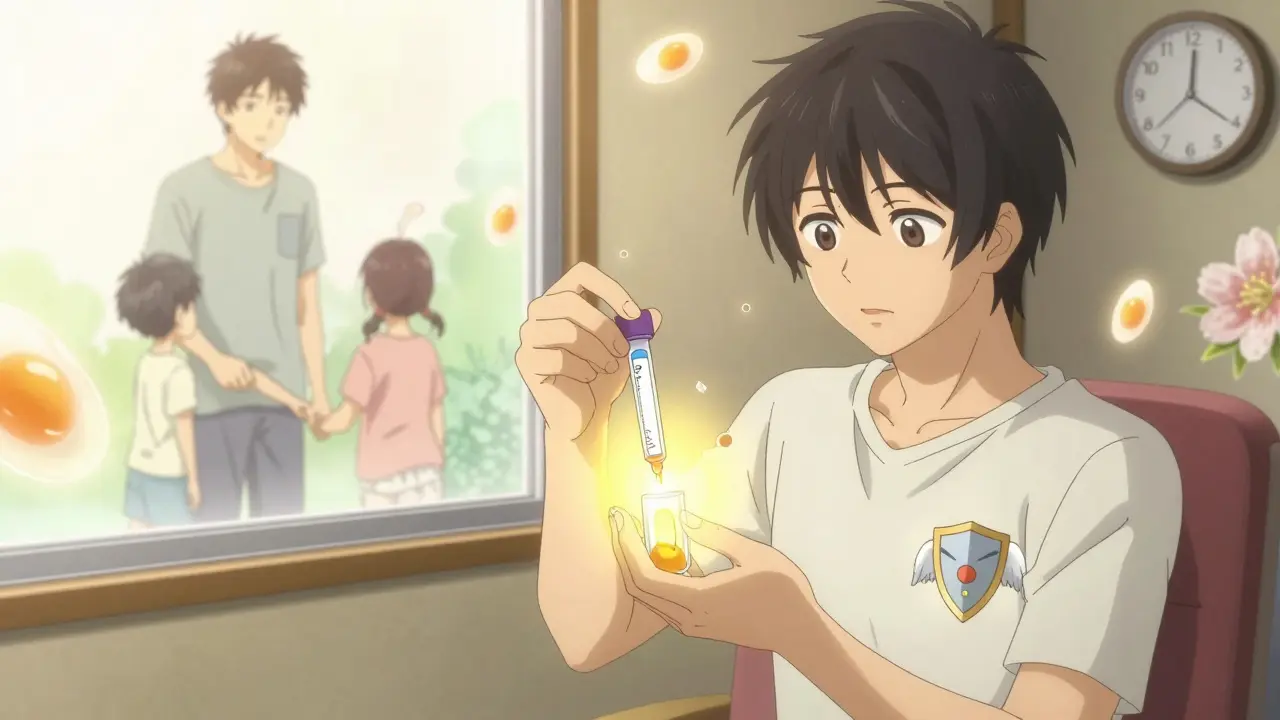
What to Do Right Now
If you or someone you love is facing chemotherapy:
- Ask your oncologist right away: ‘Can you refer me to a fertility specialist?’ Don’t wait.
- Get a consultation within 14 days. Even if you’re not sure you want kids, knowing your options reduces future regret.
- For women: If you’re prepubertal or need chemo immediately, ask about ovarian tissue freezing. If you have time, consider egg or embryo freezing.
- For men: Bank sperm. Do it now. It takes less than an hour.
- Check insurance. Some states now require coverage. Ask your hospital’s financial counselor.
- Don’t panic. Many people preserve fertility and go on to have children years later. One woman in Australia, diagnosed with breast cancer at 32, froze her eggs, completed treatment, and gave birth to twins at 37.
Emotional Weight
This isn’t just a medical decision. It’s emotional. You’re facing cancer. You’re also being asked to think about a future you’re not sure you’ll have. That’s heavy. Talk to a counselor. Join a support group. Reddit threads like r/infertility are full of people who’ve been there - sharing stories of insurance battles, failed cycles, and hard-won victories.
One woman wrote: ‘I didn’t think I’d want kids. Then I got cancer. Suddenly, the idea of never holding my own child was unbearable.’
Your fertility doesn’t define your worth. But having the choice? That matters.

Tommy Chapman
19 02 26 / 01:32 AMI can't believe people are still surprised by this. If you're gonna go through chemo, you better have your ducks in a row. No one's gonna hold your hand while you cry about losing fertility later. You think this is hard? Try being a single mom on SSDI with no support. Do the math, folks.
Robin bremer
20 02 26 / 19:42 PMthis is so real 😭 i froze my eggs after my diagnosis and now i have a 2yo 😍 also my doc was like 'uhhh maybe?' and i had to beg for a referral lmao
Hariom Sharma
22 02 26 / 07:13 AMThis is incredible! In India, we don't talk about this enough. My cousin did egg freezing before chemo and now she's a mom of two! You're not just fighting cancer-you're fighting for your future. Every woman deserves this chance. Spread this info! 🙌
aine power
24 02 26 / 04:05 AMThe FDA still calls ovarian tissue cryopreservation 'experimental.' That's not a technicality. It's negligence.
Laura B
25 02 26 / 11:26 AMI'm curious-how many oncologists actually bring this up proactively? Or do patients have to demand it? I've heard horror stories of people being told 'you're too sick to think about that.'
Nina Catherine
26 02 26 / 00:44 AMi just found out my bro is getting chemo next week and i had no idea any of this existed 😭 we're calling a fertility clinic tmrw. thank you for writing this. seriously. you just saved him from a lifetime of regret.
Irish Council
26 02 26 / 17:37 PMThey say 'act fast' but they don't mention the insurance companies are the real enemy. The same ones who deny coverage then charge you $12k/year for IVF later. This isn't medicine. It's a pyramid scheme.
Jayanta Boruah
28 02 26 / 00:52 AMThe empirical data regarding sperm banking efficacy is overwhelmingly robust, with viability retention rates consistently exceeding 40% across multiple peer-reviewed longitudinal studies, particularly when cryopreservation protocols adhere to the ASRM 2021 guidelines. One must, therefore, conclude that the biological imperative for pre-chemotherapeutic gamete preservation is not merely prudent, but ethically obligatory.
Benjamin Fox
1 03 26 / 15:41 PMbank sperm bro 🤡 it takes 10 mins. why are women making this into a whole drama? just freeze your eggs. stop being dramatic.
Freddy King
2 03 26 / 10:37 AMLet’s deconstruct this: the 'fertility preservation' industry is a $5B market built on the commodification of reproductive anxiety. The real issue isn't chemo-it's a healthcare system that monetizes trauma. Ovarian tissue freezing? It’s not science. It’s a capitalist workaround for systemic failure.
Taylor Mead
2 03 26 / 12:05 PMI’m so glad this exists. My sister did egg freezing and now she’s got a little girl. It didn’t fix everything, but it gave her something to look forward to. Don’t underestimate the power of hope. You’re not alone.
Maddi Barnes
3 03 26 / 18:13 PMOh sweetie, you're telling me that a woman who just got diagnosed with cancer has to schedule hormone injections, find a sperm donor, and fight insurance before she even gets chemo? 🤡 The system is designed to break people. And we're still acting like this is a 'choice'?
Jonathan Rutter
3 03 26 / 20:00 PMI’m not saying this is wrong, but let’s be real-how many of these people even *want* kids? I had stage 3 lymphoma at 24. I didn’t care about fertility. I cared about surviving. Now I’m 31 and I’ve got a dog and a cabin in the woods. Maybe we’re over-glamorizing motherhood as the ultimate victory lap? Maybe some people just want to live.
Jana Eiffel
4 03 26 / 00:42 AMThe ontological weight of reproductive autonomy in the context of life-threatening illness necessitates a reconfiguration of medical ethics. To present fertility preservation as a mere clinical option is to reduce human dignity to a transactional calculus. The body, in its vulnerability, demands more than procedural solutions-it demands recognition.