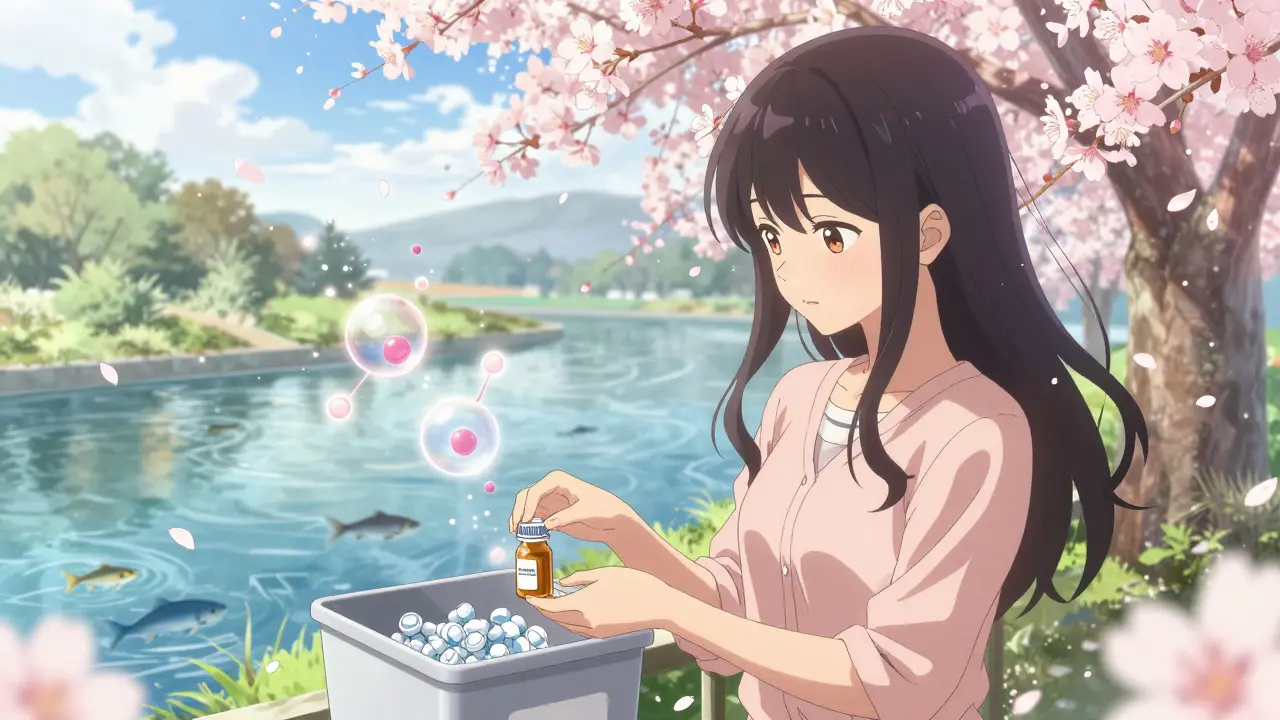
Every year, millions of unused pills, liquids, and patches end up in toilets and sinks across the world. People think flushing them is harmless-maybe even the safest option. But here’s the truth: flushing medications is one of the worst things you can do for your local waterways, fish, and even your own drinking water. It’s not just a myth. It’s science-and it’s happening right now.
What Happens When You Flush a Pill?
When you flush a medication, it doesn’t disappear. It enters the sewage system, heads to a wastewater treatment plant, and most of the time, it passes right through. These plants were never built to remove chemicals like antibiotics, painkillers, or antidepressants. They’re designed to clean out poop, soap, and dirt-not tiny drug molecules that slip through filters like ghosts.
Studies from the U.S. Geological Survey found traces of over 80 different pharmaceuticals in rivers and streams across 30 states. That includes ibuprofen, estrogen from birth control pills, and even antidepressants. In some places, fish are growing female organs because of estrogen exposure. Other fish are showing reduced fertility, slower growth, and strange behaviors. It’s not science fiction-it’s what’s in the water.
And it’s not just fish. These drugs can leach into groundwater, which feeds wells and drinking water supplies. While concentrations are usually very low-nanograms per liter-they’re still there. And we don’t fully understand the long-term effects of decades of low-dose exposure in humans. But we do know that antibiotics in the environment contribute to antibiotic resistance, a global health crisis already killing over 1.2 million people a year.
Why Flushing Is Only One Part of the Problem
You might think flushing is the biggest source of pollution. It’s not. The biggest source? Your body.
About 70-80% of a medication you take gets excreted unchanged. That’s right-most of the drug you swallow ends up in your urine or stool. That’s natural. Your body doesn’t absorb everything. But here’s the catch: when you flush unused pills, you’re adding extra doses that your body never touched. That’s avoidable pollution.
Landfill disposal is another major pathway. People throw old meds in the trash, where rainwater washes them into soil and groundwater. One study found acetaminophen levels in landfill leachate as high as 117,000 ng/L. That’s over a thousand times higher than what’s found in treated wastewater. So whether you flush or trash it, you’re still dumping drugs into the environment.
What Medications Are Safe to Flush?
The FDA used to say:
“Don’t flush.” Then they made a list. Now they say:
“Only flush these.”
There’s a short list of medications-only about 15-that the FDA says you can flush if you can’t get to a take-back program. These are drugs with high abuse potential, like fentanyl patches, oxycodone, and methadone. Why? Because if a child or pet finds them in the trash, they could die from a single dose. The risk of overdose outweighs the environmental risk.
Everything else? Don’t flush it. Not ibuprofen. Not your blood pressure pills. Not your antibiotics. Not your antidepressants. Not even your expired vitamins. Flush only if it’s on the FDA’s official flush list and you have no other option.
The Best Alternative: Take-Back Programs
The cleanest, safest, and most effective way to dispose of unused medications? Take them back.
Pharmacies, hospitals, and police stations often have drop-off bins. In Australia, many pharmacies participate in the National Medicines Take Back Program. In the U.S., the DEA runs National Prescription Drug Take Back Days twice a year, and over 2,000 permanent collection sites exist nationwide.
These programs collect meds, then incinerate them at high temperatures-completely destroying the chemicals. No runoff. No leaching. No contamination.
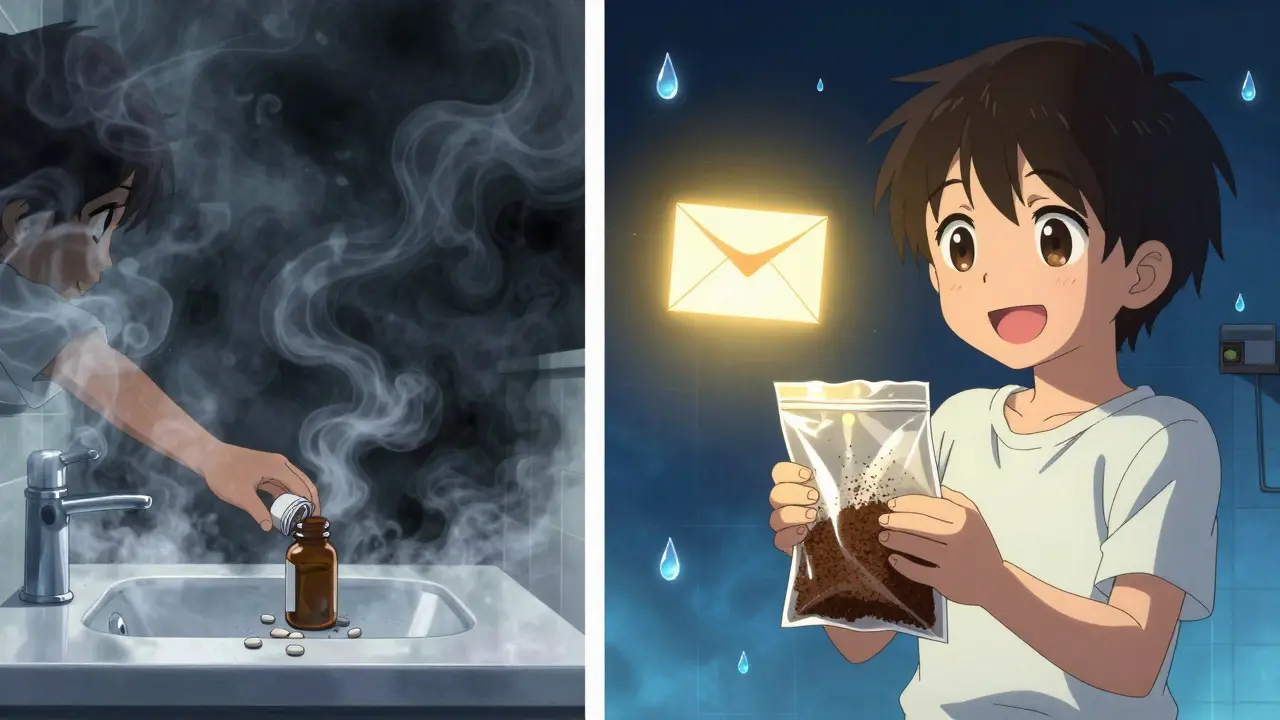
The problem? Most people don’t know where to go. A 2021 FDA survey found only 30% of Americans knew take-back programs existed. In rural areas, the nearest drop-off might be 30 minutes away. That’s a barrier. But it’s not impossible. Many pharmacies now offer mail-back envelopes for free. You pop your pills in, seal it, drop it in the mailbox. Done.
What If There’s No Take-Back Option?
If you live somewhere with no drop-off sites and no mail-back service, here’s what the EPA recommends:
- Take the pills out of their original bottles.
- Mix them with something unappetizing-used coffee grounds, cat litter, or dirt.
- Put the mixture in a sealed plastic bag or container.
- Throw it in the trash.
Don’t crush pills unless the label says it’s safe. Don’t pour liquids down the drain. Don’t rinse bottles and flush the rinse water. And never leave meds in unsealed containers where kids or pets can get to them.
This method isn’t perfect-it still ends up in a landfill-but it’s far safer than flushing. It also prevents accidental poisoning.
Why This Matters Beyond the Environment
This isn’t just about fish or water quality. It’s about responsibility.
We live in a culture of overprescribing. People get antibiotics for viral infections. They get painkillers for minor aches. They stockpile meds “just in case.” Then they forget about them. By the time they remember, the pills are expired, and the only solution they know is the toilet.
But if we all took just five minutes to check if we had old meds in our cabinets, and then took them to a drop-off point, we could cut household pharmaceutical waste by 60-75%, according to German research.
It’s also about equity. Low-income families can’t afford to drive 20 miles to a take-back site. Mail-back programs need internet access and postage. We need better infrastructure-not just better behavior.
What’s Changing? What’s Coming?
Europe is ahead. The EU now requires drug manufacturers to pay for take-back programs. That’s called Extended Producer Responsibility. It forces companies to think about the full lifecycle of their products-not just the sale.
In California, as of January 1, 2024, pharmacies must give you disposal instructions with every prescription. No more guessing.
New technologies are being tested too-like advanced filtration systems that remove 95% of pharmaceuticals from wastewater. But they cost millions to install. That’s not a fix for individuals. It’s a fix for cities.
The real solution? Prevention. Prescribe less. Educate patients. Encourage refill-only models. Don’t hand out 90 pills when 30 will do.
What You Can Do Today
1.
Check your medicine cabinet. Look for expired, unused, or discontinued meds.
2.
Find a drop-off location. Search online for “medication take-back near me” or check with your local pharmacy.
3.
Use mail-back if available. Many pharmacies offer free return envelopes.
4.
Only flush if it’s on the FDA’s list and you have no other option.
5.
Dispose of the rest safely in trash. Mix with coffee grounds or cat litter. Seal it. Toss it.
6.
Ask your doctor. When you get a new prescription, ask: “Do I really need all of these?”
It’s not about being perfect. It’s about being better than before.
Why This Isn’t Just ‘Someone Else’s Problem’
You drink water. You eat fish. You breathe air. You live on this planet.
The drugs you flush today might be in your tap water tomorrow. The antibiotics that end up in rivers help create superbugs. The hormones in fish could affect human fertility down the line.
We don’t need to wait for governments or corporations to fix this. We can start now-with one pill, one bottle, one trip to the pharmacy.
You don’t need a degree in environmental science. You just need to care enough to act.
Is it ever okay to flush medications?
Only if the medication is on the FDA’s official flush list-currently about 15 high-risk opioids like fentanyl and oxycodone. These are drugs that can cause fatal overdose if found by children or pets. For all other medications, flushing is not recommended. Even if your doctor or pharmacist says it’s fine, double-check the FDA’s current list. It changes occasionally.
Can I just throw medications in the trash without mixing them?
It’s not recommended. Leaving pills in their original bottles makes them easy for kids, pets, or people looking for drugs to find. The EPA advises mixing them with something unappealing like coffee grounds or cat litter and sealing them in a container before tossing. This reduces the risk of accidental poisoning and misuse.
Do take-back programs accept all types of medications?
Most programs accept prescription pills, liquids, patches, inhalers, and even over-the-counter meds like ibuprofen or allergy pills. They usually don’t accept needles, sharps, or illegal drugs. Some locations may not accept creams or inhalers-always check with the site beforehand. If in doubt, call ahead.
Why can’t wastewater plants remove these drugs?
Wastewater plants are designed to remove solids, bacteria, and nutrients-not tiny, complex chemical molecules like pharmaceuticals. These compounds are dissolved in water and pass through filters and biological processes unchanged. Some even break down into more toxic byproducts. Advanced treatment like ozone or activated carbon can remove them, but it’s expensive and not standard in most plants.
Are there any at-home solutions to destroy medications safely?
Yes, products like Drug Buster or MedTakeBack use chemical degraders to break down pills into non-toxic compounds. But they’re expensive ($25-$30 per unit), require precise use, and aren’t widely available. They’re not practical for most households. For now, take-back programs and the EPA’s trash disposal method remain the most reliable and affordable options.
What happens to medications after they’re dropped off?
Collected medications are transported to licensed incineration facilities. They’re burned at temperatures above 1,000°C, which completely destroys the chemical structure of the drugs. No residue remains. This is the only method that ensures zero environmental release. Landfilling or composting is not used for collected pharmaceuticals.
Is it true that flushing contributes less than excretion?
Yes, most pharmaceutical pollution comes from people excreting unused portions of drugs they’ve taken. But flushing unused pills adds extra, avoidable contamination. Even if it’s a smaller portion, it’s still preventable. And when you combine flushing with landfill disposal, improper disposal becomes a major contributor. Reducing it helps lower the total load.

Pavan Vora
5 01 26 / 12:13 PMi mean... seriously? we flush pills like they're toilet paper?? in india we just leave em in the corner of the cupboard till they turn to dust... but honestly? this post opened my eyes. 🤯
Joann Absi
6 01 26 / 18:57 PMAMERICA IS THE ONLY COUNTRY THAT DOES THIS RIGHT 😤 FLUSHING IS A LIBERAL LUXURY. WE DON'T HAVE TIME FOR THIS ENVIRONMENTAL WANKING. JUST THROW IT IN THE TRASH LIKE A NORMAL PERSON. 🇺🇸🔥
Jeane Hendrix
7 01 26 / 13:18 PMthis is such a critical issue that gets zero attention in med school. the pharmacokinetics of excretion + environmental persistence = a perfect storm. we're essentially running a slow-motion toxicology experiment on aquatic ecosystems. and the worst part? no one's tracking bioaccumulation in human tissue over decades. 🤔
Rachel Wermager
8 01 26 / 20:14 PMWastewater treatment plants aren't designed for micropollutants. The hydraulic retention time is too short, and biological degradation is inefficient for lipophilic compounds. You need advanced oxidation processes or granular activated carbon - neither of which are economically viable at municipal scale. This isn't a behavioral problem - it's an engineering failure.
Leonard Shit
10 01 26 / 12:27 PMso... we're supposed to mix our xanax with coffee grounds now? 🤡 i'm just glad i don't have to worry about this since i only take tylenol and i throw the bottle out with the recycling. (oops, that's not right either, is it?)
Brian Anaz
10 01 26 / 23:13 PMwhy are we even talking about this? the real problem is doctors overprescribing. if you don't need 90 pills, don't get 90 pills. end of story. stop making everyone feel guilty for having meds at home.
Venkataramanan Viswanathan
11 01 26 / 06:58 AMIn India, we do not have take-back programs. We keep medicines in locked cabinets. Children do not touch them. We do not flush. We do not throw in trash. We wait until they expire. Then we burn them in small quantities in backyard. It is not ideal, but it is what we do.
Vinayak Naik
12 01 26 / 13:11 PMbro, i just dumped my grandma's old heart meds in the trash like a savage. then i remembered this post and went back with a bag of wet coffee grounds. now they're chillin' in a sealed Tupperware like a bad drug deal. 🤫☕ #medsarenottrash
Kiran Plaha
13 01 26 / 06:30 AMi never thought about this before. but now that you mention it... my dad used to flush his blood pressure pills every time he got a new prescription. i think i need to talk to him.
Matt Beck
14 01 26 / 20:52 PMwe're all just tiny drops in a vast ocean of corporate negligence... but still... 🌊💧 maybe if we each flush one less pill, we collectively drown the system in moral clarity. 🙏💊
Kelly Beck
16 01 26 / 13:52 PMyou know what? this is actually so empowering! 🌱✨ you don't need to be perfect - you just need to start. find one old pill bottle today. mix it with cat litter. seal it. toss it. that's one less toxin in our water. you got this! 💪❤️
Molly McLane
17 01 26 / 06:39 AMi love that this post includes rural communities. not everyone has a pharmacy down the street. mail-back envelopes are a game-changer. i just sent mine last week. it felt like returning a library book - simple, responsible, quiet victory.
Beth Templeton
17 01 26 / 10:08 AMflushing = dumb. trash = slightly less dumb. take-back = ideal. stop overprescribing = genius. why is this even a conversation?
Ryan Barr
17 01 26 / 11:57 AMIf you're worried about pharmaceutical pollution, you should probably stop eating fish entirely. Also, your tap water has more microplastics than ibuprofen. Priorities.
Dana Termini
17 01 26 / 16:44 PMi appreciate how this doesn't just shame people. it gives real options. even the trash method is better than flushing. that’s the kind of guidance we need - not guilt, just clarity.