
Switching from one digoxin generic to another might seem like a simple cost-saving move - but for patients with heart failure or atrial fibrillation, it can be dangerous. Unlike most generic drugs, digoxin doesn’t play by the usual rules. Even small changes in how much of the drug gets into your bloodstream can mean the difference between effective treatment and life-threatening toxicity.
Digoxin is a cardiac glycoside used for decades to help weak hearts pump better and control irregular rhythms. But it’s not like taking a generic ibuprofen. It has a narrow therapeutic index - meaning the gap between a helpful dose and a toxic one is razor-thin. The safe range? Just 0.5 to 2.0 nanograms per milliliter in your blood. Go a little over, and you risk vomiting, blurred vision, or dangerous heart rhythms. Go a little under, and your heart failure symptoms come roaring back.
Because of this, the FDA treats digoxin like a new drug, even when it’s generic. Every manufacturer must prove their version works the same as the brand-name Lanoxin. To get approval, the 90% confidence interval for absorption - measured by AUC and Cmax - must fall between 80% and 125% of Lanoxin’s levels. That’s stricter than most generics. But here’s the catch: that range applies to groups of people, not individuals.
A 2004 study in Saudi Arabia tested a generic digoxin (Cardixin) against Lanoxin in 12 healthy men. The average absorption was within the acceptable range. On paper, it was bioequivalent. But what if one person in that group only absorbed 45% of the drug? That’s way below the 80% threshold. Yet because other people absorbed more, the average still passed. That’s how a generic can be approved even if some patients get far less - or far more - than intended.
That’s the real problem with digoxin generics. The system is built for population averages. But patients aren’t averages. An 80-year-old with kidney trouble, on five other medications, might absorb digoxin at 30% efficiency. Another person, younger and healthy, might absorb 90%. Same pill. Different results.
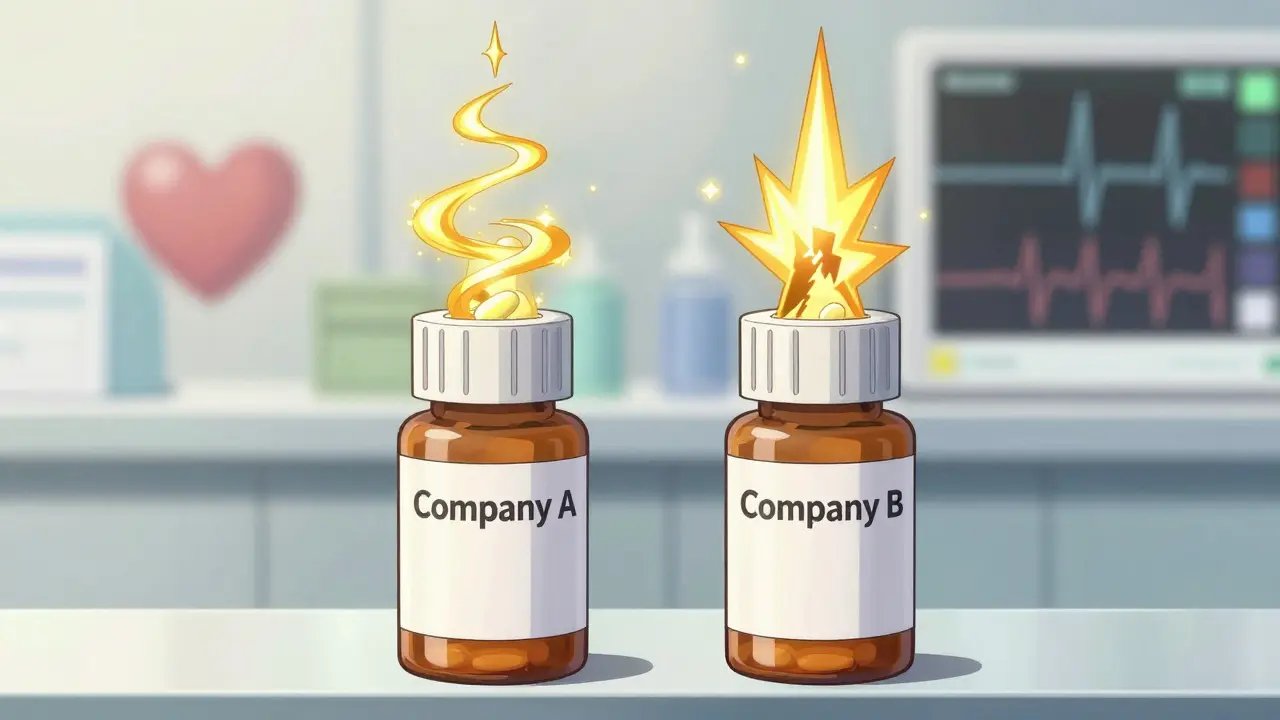
And it gets worse when you switch between generics. There are no studies comparing one generic to another. If you’re on a generic made by Company A, and your pharmacy switches you to Company B without telling you, your blood levels could jump or drop by 25% or more. That’s not a minor fluctuation - that’s enough to trigger toxicity or cause your heart condition to worsen.
Studies from Estonia and Saudi Arabia show that some generic digoxin products are bioequivalent to Lanoxin. That’s good news. But those studies don’t tell you if Generic A is the same as Generic B. The FDA’s Orange Book lists three generic digoxin tablets with an ‘AB’ rating - meaning they’ve passed bioequivalence testing against Lanoxin. But none of those studies compare the generics to each other.
Real-world reports confirm the risk. Clinicians have documented cases where switching between generics caused digoxin levels to spike into toxic territory - without any change in dose. One patient developed severe arrhythmias after a pharmacy substitution. Another slipped into heart failure because the new generic wasn’t absorbed well. Neither case was flagged until blood tests were done.
Even the formulation matters. Digoxin elixir (liquid) is absorbed better - 70% to 85% - than tablets. So if you switch from a tablet to a liquid, or vice versa, your dose needs recalibration. This isn’t just about brand vs. generic. It’s about every single change in the drug you take.
If you’re on digoxin, you need regular blood tests. Not once a year. Not when you feel bad. You need them after every change: new pharmacy, new generic, new kidney meds, new dose. The American College of Clinical Pharmacy says to measure trough levels - the lowest point in your cycle - just before your next dose. Target: 0.5 to 0.9 ng/mL for heart failure patients. Higher levels don’t help - they hurt.
And timing matters. Digoxin takes days to reach steady state because of its long half-life. If you switch formulations, wait 3 to 5 days before testing. Don’t assume your old dose is right for the new pill. Your doctor might think, “It’s the same drug,” but it’s not - not in your body.
Watch for symptoms. Nausea, loss of appetite, yellow-green halos around lights, confusion, or an irregular pulse? These aren’t side effects to ignore. They’re red flags. Elderly patients are at highest risk. Their kidneys clear digoxin slower. They’re often on multiple drugs that interact. And they’re less likely to notice subtle changes until it’s too late.
Best practice? Stick with one manufacturer. If you’re stable on Generic X, don’t switch unless you have to. If your pharmacy switches you, ask why. Demand to know the brand name of the generic you’re getting. Keep a list: “I take digoxin from Company A - do not substitute.”
Prescribers should avoid switching digoxin products unless absolutely necessary. The American Heart Association and American College of Cardiology both say: Use the same manufacturer’s product whenever possible. That’s not a suggestion - it’s a safety rule.
When a switch is unavoidable, check digoxin levels within 5 days. Adjust the dose based on results, not assumptions. Don’t rely on “it’s the same dose.” It’s not the same drug in your body.

If you take digoxin:
Don’t assume generics are interchangeable. For digoxin, they’re not. The science says they can be bioequivalent - but your body doesn’t care about population averages. It only responds to what’s in your bloodstream.
Digoxin isn’t the only narrow therapeutic index drug. Tacrolimus, warfarin, and lithium have similar risks. But digoxin is one of the most common - and one of the most misunderstood. We assume generics are safe because they’re cheaper. But with NTI drugs, cost savings shouldn’t come at the cost of safety.
The system works on paper. But real people - with real kidneys, real diets, real meds - don’t fit neatly into study groups. That’s why monitoring isn’t just good practice. It’s non-negotiable.
If you’re on digoxin, your care shouldn’t depend on which factory made your pill. It should depend on your blood levels - and your doctor paying attention to them.

Robert Way
16 01 26 / 08:13 AMso i switched my digoxin to the cheap one last month and now i keep seeing yellow circles around lights?? thought i was going crazy lol. doc says its toxic and i almost died. why does this even happen??
Sarah Triphahn
16 01 26 / 16:18 PMclassic. people think generics are all the same because they look identical. but digoxin isn't aspirin. your body doesn't care about the label, it cares about what's actually in the pill. if your kidney function dips even a little, that 5% difference in absorption becomes a death sentence. this isn't about cost, it's about arrogance in the system.
Jason Yan
18 01 26 / 12:23 PMyou know what's wild? we treat digoxin like it's some ancient relic from the 1950s, but the science behind it is incredibly precise. the fact that we're still letting pharmacists swap out manufacturers without checking levels is like letting someone swap your insulin for a different brand and saying 'it's glucose, right?' we're not just being cheap here-we're gambling with lives. and honestly, if your doctor doesn't know this, you need a new one.
shiv singh
18 01 26 / 17:49 PMpharma companies are laughing all the way to the bank. they know people won't check their blood levels. they know doctors are too busy. they know patients won't ask. this isn't an accident-it's a business model. they make the cheap version, get approved by the FDA with a tiny margin of error, and then let old people die quietly while saving a few cents per pill. this is murder by spreadsheet.
Sarah -Jane Vincent
19 01 26 / 09:02 AMwait-so you're saying the FDA is lying? they approved these generics so they must be safe. this sounds like a conspiracy. maybe you're just paranoid because you don't trust big pharma. maybe your doctor just messed up your dose. why blame the generic? maybe you're just allergic to saving money.
Henry Sy
20 01 26 / 04:57 AMmy grandma took digoxin for 12 years on the same generic. one day the pharmacy switched her to a new one-no warning. she started hallucinating, thought the cat was her dead husband, and ended up in the ER with a heart rate of 140. they had to pump her stomach. turns out the new batch had 30% higher bioavailability. she’s fine now. but she’ll never take a different brand again. i keep a photo of her pill bottle on my phone. if you’re on digoxin, do the same.
Alvin Bregman
21 01 26 / 10:38 AMthe real issue is we treat medicine like cereal. you grab the box on sale. but digoxin isn't frosted flakes. your body doesn't do averages. it does exact. if your kidneys are slow or you're on a statin or you drank grapefruit juice that morning-it changes everything. we need to stop pretending one pill fits all. this isn't rocket science, it's biology
Anna Hunger
22 01 26 / 18:01 PMIt is imperative that clinicians adhere to evidence-based guidelines regarding digoxin monitoring. The American College of Clinical Pharmacy explicitly recommends trough level assessment within 3 to 5 days following any formulation change. Failure to do so constitutes a deviation from the standard of care and exposes patients to undue risk. Documentation of the manufacturer and batch number should be mandatory in all electronic health records.
Vicky Zhang
23 01 26 / 09:25 AMi had a friend who was on digoxin for AFib and switched generics because her insurance changed. she started feeling like she was drowning in slow motion-couldn't breathe, dizzy, her hands were shaking. she thought it was stress. three weeks later, she collapsed. turned out her levels were 3.8 ng/mL. toxic. she had to be put on a ventilator. now she only takes the brand name and her family pays out of pocket. no amount of savings is worth almost dying.
Allison Deming
25 01 26 / 05:23 AMIt is profoundly disturbing that the regulatory framework permits the interchangeability of digoxin generics without comparative bioequivalence data between formulations. The FDA's AB rating system, while technically compliant, is fundamentally inadequate for drugs with a narrow therapeutic index. This regulatory gap is not merely an oversight-it is an institutional failure that prioritizes fiscal efficiency over patient safety. The medical community must demand systemic reform.
Susie Deer
26 01 26 / 02:42 AMwe dont need all this science talk. if you cant afford the good stuff, you shouldnt be on the drug. america is full of people who want free stuff then cry when it kills them. take the brand or dont take it. simple.
TooAfraid ToSay
26 01 26 / 12:45 PMin nigeria we don't even have generic digoxin. we use the brand because the cheap ones are fake. sometimes they have no active ingredient. sometimes they have rat poison. so i don't get why americans are surprised. you think your system is better? you're just better at pretending the danger isn't real.