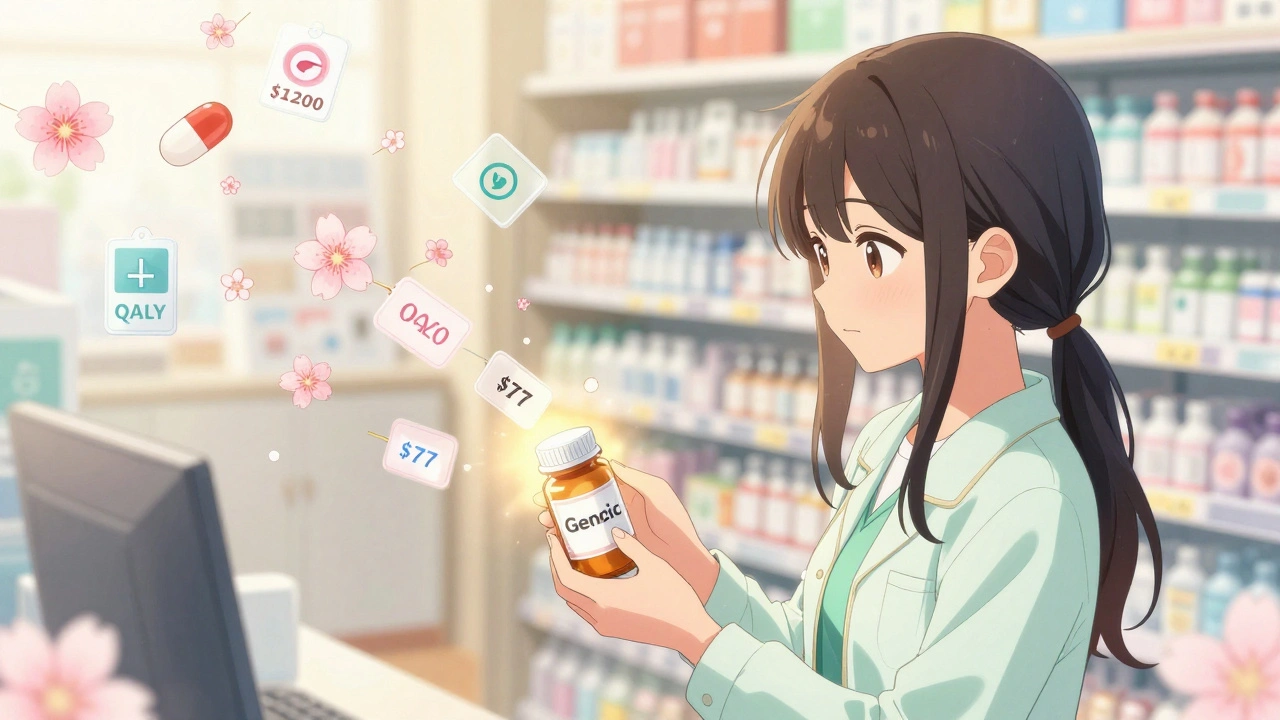
When you pick up a prescription, you might not think about how much it costs the healthcare system - or how much it could cost if you didn’t have a generic option. But behind every pill, every injection, every refill, there’s a quiet economic battle being fought. Generic drugs are the unsung heroes of modern healthcare, saving billions every year. But not all generics are created equal. Some cost 10 times more than others, even when they do the exact same thing. That’s where cost-effectiveness analysis comes in - a practical, data-driven way to figure out which drugs give you the most health for your money.
What Is Cost-Effectiveness Analysis (CEA) and Why Does It Matter?
Cost-effectiveness analysis, or CEA, isn’t about cutting corners. It’s about cutting waste. At its core, CEA compares how much a treatment costs versus how much health it delivers. The standard unit of health is called a QALY - quality-adjusted life year. One QALY equals one year of perfect health. If a drug extends your life by two years but you’re bedridden the whole time, it might only count as 0.5 QALYs per year. CEA looks at the total cost divided by total QALYs gained. The lower the cost per QALY, the better the value.
For generic drugs, this gets even more interesting. A brand-name drug might cost $500 a month. When the patent expires, the first generic hits the market - and suddenly, the price drops 40%. By the time six generics are competing, that same drug might cost less than $10. That’s not a coincidence. That’s market dynamics in action. But here’s the problem: most cost-effectiveness studies still treat generics like static prices. They assume the price today is the price forever. That’s like planning a road trip using a map from 1995. The world has moved on.
The Real Savings: How Generics Cut Costs by 95%
The numbers don’t lie. According to the FDA, when the first generic enters the market, the brand-name drug’s price falls by an average of 39%. When six or more generic manufacturers start selling the same drug, prices plunge more than 95% below the original. That’s not inflation. That’s competition.
Between 2007 and 2017, generic drugs saved the U.S. healthcare system $1.7 trillion. In 2022, generics made up 90% of all prescriptions filled - but only 17% of total drug spending. That’s the power of scale and competition. But here’s where things get messy.
A 2022 study in
JAMA Network Open looked at the top 1,000 most-prescribed generics. It found 45 of them were being sold at prices 15.6 times higher than other drugs in the same therapeutic class - drugs that worked just as well. One example: a generic version of a common blood pressure medication priced at $1,200 per month, while another generic, doing the same job, cost just $77. That’s not a difference in quality. That’s a difference in pricing strategy.
If every patient switched to the cheaper option, total spending on those 45 drugs would have dropped from $7.5 million to under $900,000. That’s an 88% savings. And yet, many of these high-cost generics are still on insurance formularies. Why?
Why Are Some Generics So Expensive?
It’s not because they’re better. It’s because of how the system works.
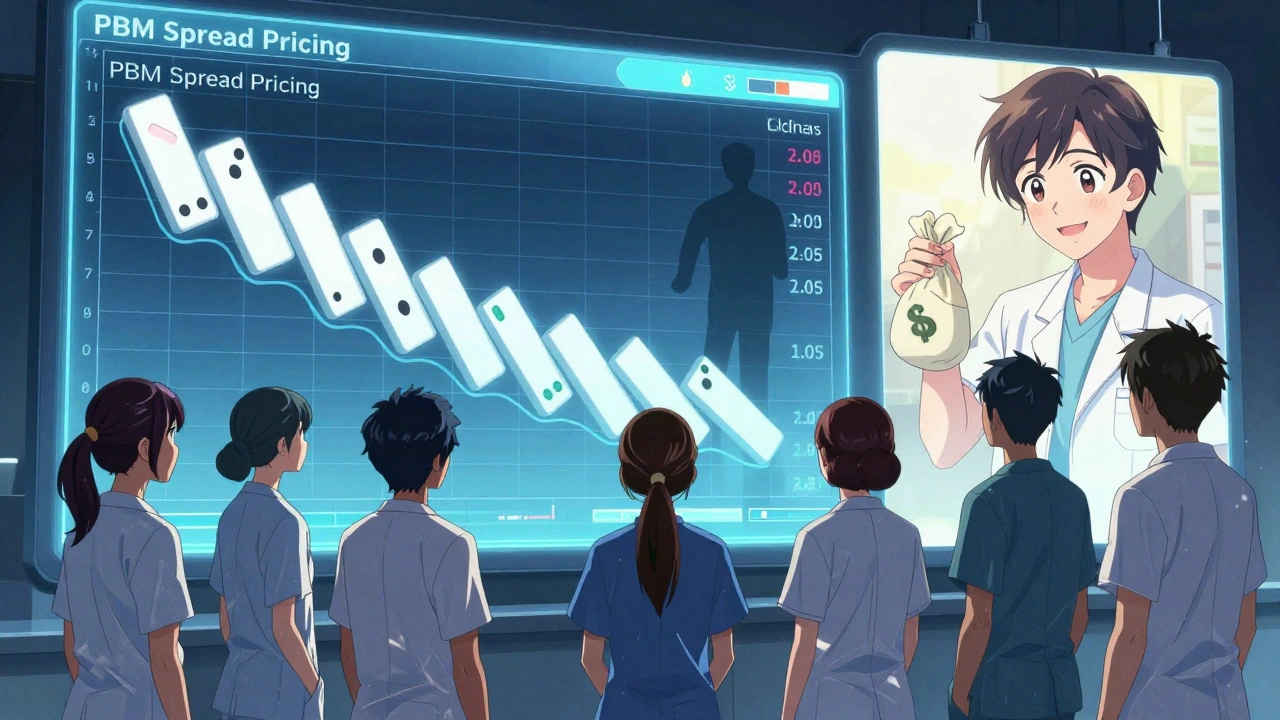
Pharmacy Benefit Managers (PBMs) - the middlemen between insurers, pharmacies, and drugmakers - often profit from something called “spread pricing.” They negotiate a price with the pharmacy (say, $1,200 for that expensive generic), then pay the insurer less (say, $800). The $400 difference? That’s their cut. So if a cheaper generic exists at $77, but the PBM is making $323 off the $400 version, they have no incentive to switch. The system rewards high prices, not low costs.
Even worse, some insurers don’t even know cheaper alternatives exist. Their formularies are built on old data, outdated contracts, or vendor recommendations. A pharmacist might know a cheaper option is available - but if the system won’t let them switch without prior authorization, the patient gets stuck paying more.
How CEA Gets It Wrong - And How to Fix It
Here’s the biggest flaw in most cost-effectiveness studies: they ignore the future.
A 2021 ISPOR conference paper found that 94% of published CEA studies on drugs didn’t account for what happens after a patent expires. They used today’s brand-name price as the baseline - even if the patent was set to expire in six months. That makes branded drugs look more cost-effective than they are. It also makes generics look like a risky bet, when in reality, they’re the inevitable outcome.
The VA Health Economics Resource Center says this is a serious bias. If you don’t model future generic entry, you’re not doing CEA - you’re doing guesswork. The right way to do it? Forecast when generics will enter. Estimate how many manufacturers will compete. Model how prices will drop over time. That’s not easy. It requires access to patent expiration dates, manufacturing capacity data, and historical price trends.
The NIH’s 2023 framework suggests three rules for better CEA:
- Design processes that match the speed of the market - don’t wait a year to update your analysis.
- Compare all treatment options, not just the brand and the first generic.
- Update your decision rules as new generics appear.
That last one is critical. A drug might have been cost-effective at $300 a month with one generic. But when three more enter and the price drops to $40, the same drug becomes a no-brainer. If your decision rules don’t adapt, you’re leaving money - and health - on the table.
Therapeutic Substitution: The Hidden Opportunity
You don’t always need to switch to another generic of the same drug. Sometimes, switching to a different drug in the same class saves even more.
The JAMA study showed that when patients switched from a high-cost generic to a lower-cost drug in the same therapeutic class - say, from one statin to another - prices dropped by a median of 20.6 times. That’s not just savings. That’s a revolution in care.
But here’s the catch: doctors don’t always know. Pharmacists don’t always have the tools. Insurance plans don’t always allow it. Many formularies still treat all drugs in a class as interchangeable - even when they’re not. A patient on a $1,200 generic might be perfectly fine on a $60 alternative. But without clear guidance, they’re stuck paying more.

Global Differences: Why Europe Does It Better
In the U.S., only 35% of commercial insurers use formal cost-effectiveness analysis when deciding which drugs to cover. In Europe, over 90% of health technology assessment agencies do. Why? Because they’ve made it part of the system.
In the UK, the National Institute for Health and Care Excellence (NICE) sets a clear threshold: if a drug costs more than £20,000-£30,000 per QALY, it’s usually not funded. That doesn’t mean it’s bad - it just means it’s not good enough for the money. Generics almost always fall below that line.
In Germany, price negotiations happen before a drug even hits the market. Manufacturers have to prove their drug offers real value - and if a generic is already available, they’re expected to match it. The result? Lower prices, faster access, and smarter spending.
The U.S. is starting to catch up. The 2022 Inflation Reduction Act gives Medicare new power to negotiate drug prices. The 2020 Drug Pricing Reduction Act pushed Medicare Part D to favor generics. But without consistent CEA, these policies won’t reach their full potential.
What Patients and Providers Can Do
You don’t need to be an economist to make smarter choices.
If you’re on a generic drug and it’s expensive:
- Ask your pharmacist: “Is there a cheaper generic or alternative drug that works the same?”
- Check GoodRx or SingleCare - they show real-time prices at nearby pharmacies.
- Ask your doctor if switching to a different drug in the same class is safe.
- If your insurance denies a cheaper option, file an appeal. You have rights.
For providers:
- Don’t assume your formulary is up to date. Prices change every week.
- Use tools like the VA’s Drug Database or ICER’s reports to find lower-cost alternatives.
- Advocate for formulary updates that reflect real-world pricing, not old contracts.
The Future of Generic Pricing and CEA
Over 300 small-molecule drugs will lose patent protection between 2020 and 2025. That means more generics. More competition. More savings.
But only if we get the analysis right. The future of cost-effectiveness analysis isn’t about static numbers. It’s about dynamic modeling - predicting price drops, tracking competitor entry, and updating decisions in real time. The NIH is already building frameworks for this. The question is: will payers, pharmacies, and providers adopt them?
The goal isn’t to make drugs cheaper for the sake of it. It’s to make sure every dollar spent on medicine delivers the most health possible. Generics are the easiest way to do that. But only if we stop paying for the wrong ones.

Jay Everett
3 12 25 / 17:09 PMBro, this is wild. I got my blood pressure med for $77 last month, then saw my buddy paying $1,200 for the same damn thing. Pharmacy told me it was ‘formulary-approved.’ Like, what even is that? A magic spell? 😅
Laura Baur
4 12 25 / 01:42 AMIt’s not just about pricing-it’s about systemic moral decay. We’ve turned healthcare into a casino where the house always wins, and the patients are the ones left holding bankrupt tickets. The fact that PBMs profit from keeping prices high isn’t a flaw-it’s the design. And we call this a free market? Please. This is feudalism with a corporate logo.
Every time a patient is denied a $60 alternative because some middleman’s commission depends on the $1,200 version, it’s not an accident. It’s a choice. A choice made in boardrooms, not clinics. And we wonder why people distrust the system?
There’s no such thing as ‘market efficiency’ when the market is rigged. Generics should be the baseline, not the exception. The fact that we need a 20-page analysis to prove that $77 is better than $1,200 is the real tragedy.
And yet, the same people who scream about ‘socialized medicine’ in Canada are perfectly fine with paying $1,200 for a pill because their insurance broker got a kickback. Hypocrisy isn’t a character flaw here-it’s the business model.
Let me be clear: this isn’t about affordability. It’s about dignity. No one should have to choose between their health and their paycheck because someone else figured out how to monetize desperation.
We don’t need more studies. We need accountability. We need to break the PBM monopoly. We need to force transparency. We need to stop treating medicine like a commodity and start treating it like a human right.
And until we do, every ‘cost-effective’ analysis is just a fancy word for ‘we’re okay with you suffering.’
Steve Enck
5 12 25 / 15:38 PMWhile the empirical data presented is compelling, one must interrogate the ontological assumptions underpinning QALY-based cost-effectiveness frameworks. The reduction of human health outcomes to quantifiable units is not merely methodological-it is epistemologically violent. To assign a scalar value to life is to commodify existence itself.
Furthermore, the conflation of market competition with ethical pharmaceutical distribution reveals a latent neoliberal ideology embedded within the very structure of health economics. The assumption that price suppression equates to improved welfare ignores the structural power asymmetries inherent in patent law, regulatory capture, and the institutional inertia of formulary committees.
One might posit that the true cost-effectiveness metric should incorporate not merely the monetary outlay, but the psychosocial burden of administrative friction, prior authorization delays, and the erosion of patient autonomy induced by opaque pricing structures.
Thus, while the 95% price drop statistic is statistically significant, its normative implications remain unexamined. We must move beyond the technocratic fetishization of efficiency and recenter the patient as a subject, not a line item.
मनोज कुमार
7 12 25 / 09:16 AMPBMs are the real villains. No one talks about them. They’re the middlemen who make money off the gap. Simple. No need for fancy models. Just kill spread pricing and the problem solves itself.
dave nevogt
8 12 25 / 12:52 PMI’ve been a pharmacist for 22 years. I’ve watched this play out. The system doesn’t fail because people are lazy. It fails because it’s designed to fail patients. I’ve had patients cry because they couldn’t afford the $800 version of a drug I knew was available for $40. I’ve called insurers. I’ve filed appeals. I’ve lost count of how many times I was told, ‘It’s not on our formulary.’
But here’s the thing-they’re not lying. It’s not on the formulary because the contract was signed three years ago and no one updated it. No one’s even checking. The software doesn’t alert them. The reps don’t push it. The pharmacy benefit managers? They’re paid to keep the high-price drugs moving.
I used to think it was ignorance. Now I think it’s indifference. And that’s harder to fix than any pricing model.
Every time someone says ‘just switch to generic,’ they don’t realize the patient has to navigate a maze just to get the same pill for a tenth of the price. That’s not healthcare. That’s a tax on being sick.
And the VA database? It’s gold. But most private providers don’t even know it exists. We’re not lacking data. We’re lacking will.
Joel Deang
8 12 25 / 21:44 PMomg this is so true!! i just found out my insulin generic was 3x more than another one and i was like wtf?? i used goodrx and saved like $200 a month 😭 i feel so dumb for not checking sooner. also why do we even have formularies if they’re outdated?? like can we just… update them?? 🙏
Arun kumar
10 12 25 / 07:49 AMIndia does this better. We have 10 generics of same drug. Price drops to $1. But here? Same drug, $1200. Who's really benefiting? Not patients. Not doctors. Just middlemen. Simple.
Zed theMartian
10 12 25 / 15:51 PMOh please. You think generics are saving money? Let me tell you about the real cost: the lawsuits. The counterfeit pills. The hospitals that stock the cheapest version and then give patients seizures because it’s made in a factory with no QA. You think $77 is a win? Wait until your kidney fails because the filler in your generic was sourced from a warehouse in Bangladesh that uses rat poison as a binding agent.
This isn’t ‘savings.’ It’s a gamble with your life. And you’re calling it ‘cost-effectiveness’? That’s not analysis. That’s nihilism dressed up in spreadsheets.
Let the brand-name drugs live. Let them charge what they want. At least you know what you’re getting. This ‘race to the bottom’ isn’t progress-it’s a slow-motion massacre.
Roger Leiton
11 12 25 / 22:50 PMThis is so eye-opening. I had no idea PBMs were making money off the difference. 😳 I just thought the system was broken. But now I see it’s actually engineered to be broken. That’s terrifying. And also… kind of empowering? Like, if we all start asking pharmacists ‘is there a cheaper version?’ maybe we can start changing things from the bottom up. I’m gonna start doing that. And maybe tell my doctor too. 🙌
Ella van Rij
12 12 25 / 00:56 AMWow. So we’re supposed to be impressed that a drug went from $500 to $77? That’s not innovation. That’s capitalism doing exactly what it’s supposed to do: exploit loopholes, then pretend it’s a public service.
Meanwhile, the same people who cheered when the price dropped are now complaining because their insurance didn’t update their formulary in 2019. Honey. You’re the problem. You let them get away with this for 15 years. Now you want a medal for noticing?
Also, ‘cost-effectiveness analysis’ sounds like something a Wall Street analyst says right before they fire 300 nurses to ‘optimize margins.’
Rebecca M.
12 12 25 / 19:20 PMOh my god. I just realized I’ve been paying $1,200 for my generic for two years. I’m not mad. I’m just… disappointed. Like, I thought I was being smart. I thought generics were the cheap option. Turns out I was just the chump who didn’t ask the right questions.
Also, why does every pharmacy have a different price? Is this the new version of ‘pay what you can’? No. It’s ‘pay what they trick you into.’
I’m filing an appeal. And I’m telling everyone I know. This is ridiculous.
ATUL BHARDWAJ
14 12 25 / 07:02 AMEurope does it right. No drama. Just rules. Price caps. Transparency. Done.
Jack Dao
14 12 25 / 09:05 AMLet’s be honest. This whole ‘generic’ thing is a scam. You think the FDA doesn’t know that some of these pills are made in the same factory as the brand-name? They’re literally identical. The only difference is the label and the price tag.
So why do we pretend there’s some moral high ground here? We’re not saving money-we’re just transferring wealth from patients to the middlemen who control the formularies.
And don’t even get me started on ‘therapeutic substitution.’ That’s just doctor shopping disguised as savings. You think your doctor knows every drug in every class? Please. They’re just copying what the rep told them.
This isn’t healthcare reform. It’s a rerun of the 2008 housing crisis, but with pills instead of mortgages.
Steve World Shopping
15 12 25 / 05:49 AMIn Nigeria, we don't have generics. We have counterfeit. So your $77 drug? It might be chalk. Your $1,200? Might be real. So your analysis is irrelevant. You're optimizing for a system that doesn't exist.