When you walk into a clinic or urgent care center, you might not think about how much the doctors are paying for the antibiotics, lidocaine, or saline solutions they hand you. But behind the scenes, bulk purchasing of generic medications is quietly cutting costs across the U.S. healthcare system - and saving clinics, patients, and insurers millions every year.
Generic drugs make up over 90% of all prescriptions filled in the U.S., yet they account for just about 25% of total drug spending. That’s not an accident. It’s the result of smart, large-scale buying. When a clinic orders 10,000 units of amoxicillin instead of 500, the price per pill drops - sometimes by half. That’s the power of volume.
Bulk purchasing isn’t just about ordering more. It’s a system built on layers of discounts. Manufacturers offer direct price cuts for large orders - usually 5% to 15% off for purchases over 1,000 units. But if you’re buying 10,000 units or more, those discounts can jump to 20% or even 30%. That’s not theory - it’s documented by the Academy of Managed Care Pharmacy in their 2023 framework.
But here’s where it gets more interesting. Many clinics don’t buy directly from manufacturers. They work with distributors. And not all distributors are the same.
Primary wholesalers - McKesson, Cardinal Health, AmerisourceBergen - control about 85% of the market. They’re big, reliable, and convenient. But their discounts for generics? Often just 3% to 8%. That’s barely enough to move the needle.
Then there are secondary distributors like Republic Pharmaceuticals. They don’t have the same reach, but they specialize in bulk deals. They buy excess inventory - including short-dated stock (meds with 6 to 12 months left on the clock) - and pass the savings on. One urgent care center in Texas cut its injectable costs by 20% in two months just by switching 60% of its lidocaine and antibiotic orders to a secondary distributor.
Most clinics avoid short-dated stock. They worry about waste. But that fear costs more than the risk.
Medications with six months left on their expiration date are often sold at 20% to 30% off. If you’re using a drug like metformin or atorvastatin every day, you’re not going to run out before it expires. You’re going to use it - and save big.
One clinic in Ohio reported a 25% reduction in injectable costs just by buying short-dated stock. Their trick? They tracked usage patterns and ordered in quarterly batches instead of monthly. They also used digital inventory tools to flag expiring items 30 days out. No waste. Just savings.
It’s not magic. It’s math. And it works best for high-volume, stable medications - not specialty drugs or ones with unpredictable demand.
Not everyone benefits equally. Pharmacy Benefit Managers (PBMs) - the middlemen between insurers and pharmacies - negotiate rebates of 15% to 40% on generics. But here’s the catch: they don’t always pass those savings along.
According to the USC Schaeffer Center, for every $100 spent on retail prescriptions, $41 goes to the manufacturer, $17 covers production, and the rest? A lot of it stays with PBMs. Only about half of the rebates they negotiate actually reach the plan sponsor - whether that’s an employer, Medicaid program, or insurance company.
That’s why state Medicaid programs are forming multi-state purchasing pools. Programs like the National Medicaid Pooling Initiative (NMPI) and Sovereign States Drug Consortium (SSDC) let states combine their buying power. The result? An extra 3% to 5% in savings compared to going it alone. And those savings go straight to patient care.
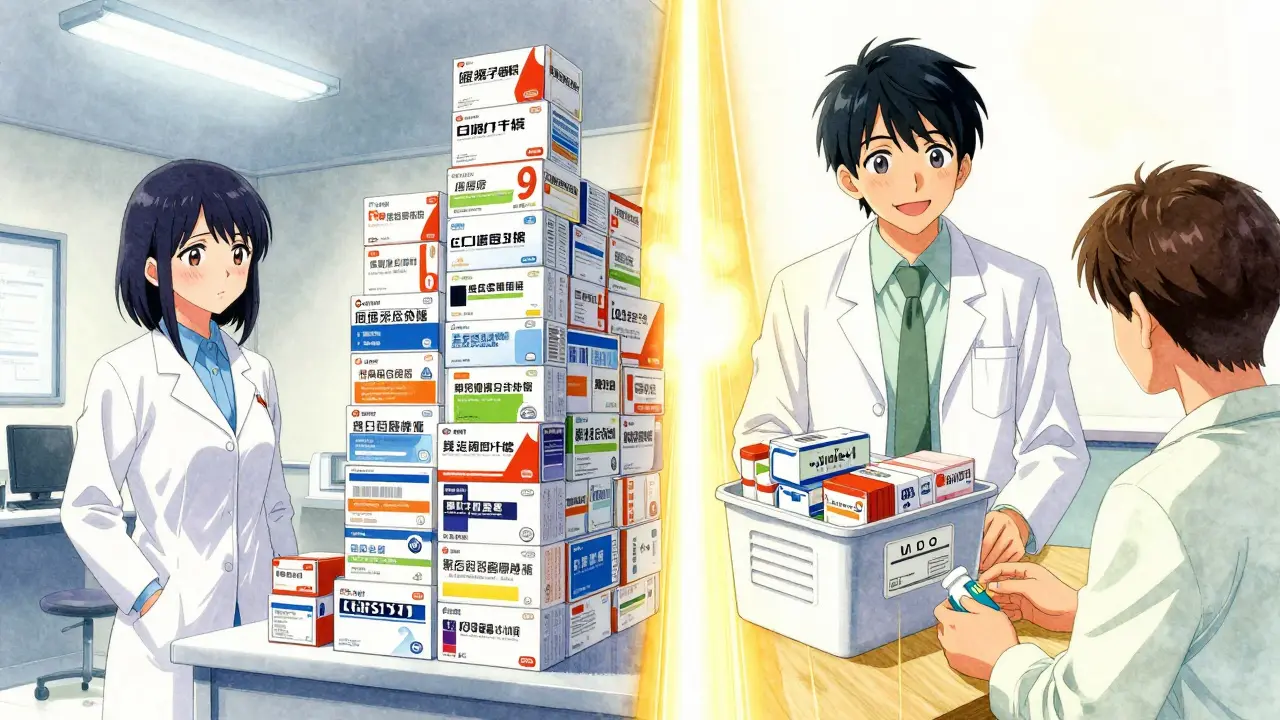
Bulk purchasing shines with certain drugs:
These are high-volume, low-complexity drugs used every day. They’re stable. Predictable. Easy to store.
But bulk buying fails in two big cases:
That’s why smart clinics don’t go all-in on bulk. They pick 15 to 20 key drugs - the ones that make up 60% to 70% of their medication spending - and focus there.
It’s not all easy money. There are trade-offs.
First, cash flow. Buying 5,000 units of a drug upfront means paying more at once. That can strain small practices. A 2023 MGMA analysis found clinics needed 15% to 25% more working capital to make bulk buying work.
Second, inventory management. Short-dated stock requires tracking. You need systems to flag what’s expiring. You need staff time to reorder before it’s too late. One clinic reported spending 20 hours in the first month just learning how to manage their new supplier.
Third, minimum order requirements. Some distributors force you to buy more than you need. One urgent care center told a survey they were stuck buying 500 units of a drug they only used 100 of - just to hit the bulk threshold. That’s not savings. That’s waste.
And then there’s consistency. Not all suppliers have the same stock. One week you get your amoxicillin. The next, it’s gone. That’s why many clinics use two or three suppliers - never just one.

If you’re a clinic, pharmacy, or provider thinking about bulk buying, here’s how to do it right:
Most clinics see real savings within 60 to 90 days. The Texas urgent care center that cut costs by 20%? They did it in two months.
Bulk purchasing won’t fix the entire drug pricing crisis. It won’t stop manufacturers from raising list prices. It won’t force PBMs to disclose their rebates. But it does give providers real power - right now, today.
With the Inflation Reduction Act starting Medicare drug price negotiations in 2026, we’re entering a new era. Those negotiated prices could drop costs by 38% to 79% for 10 key drugs. But even before that, bulk buying is already saving billions.
It’s not glamorous. No one’s writing a movie about a clinic manager checking expiration dates. But in the quiet back rooms of urgent cares, rural clinics, and community pharmacies, people are making smarter choices. And those choices are saving lives - by making essential medicines affordable.
The market is changing. Secondary distributors are growing. PBMs are rolling out point-of-sale discounts that automatically apply bulk-negotiated prices at the pharmacy counter. In 2024, you don’t need a discount card anymore - the price is just there.
But the core principle stays the same: buy smart, buy in volume, and don’t pay list price if you don’t have to.
For generic drugs, the cheapest price isn’t always the one on the label. It’s the one you negotiate - by ordering more, thinking ahead, and choosing your supplier wisely.

Mussin Machhour
23 12 25 / 18:14 PMBro, I just switched our clinic to a secondary distributor for amoxicillin and lidocaine-cut our costs by 22% in 45 days. No magic, just dumb math. We started with 2,000 units instead of 500, and now we’re doing it for metformin next. Seriously, if you’re still buying from McKesson at list price, you’re leaving cash on the table.
Also, short-dated stock? Don’t be scared. We’ve had zero waste in 8 months. Just use the EHR alerts and order quarterly. It’s not rocket science.
Carlos Narvaez
25 12 25 / 05:45 AMHow quaint. You think bulk buying is innovation? It’s basic economics. The real scandal is that PBMs still siphon 60% of rebates while clinics struggle to afford insulin. Your 20% savings are just crumbs from a table set by monopolists.
Harbans Singh
26 12 25 / 14:30 PMThis is actually brilliant. I work in a small clinic in rural India, and we’ve been doing something similar with insulin and antibiotics for years-buying in bulk from regional cooperatives. The key is trust and consistency. We don’t have fancy EHR systems, just handwritten logs and a shared calendar for expiration dates.
What’s fascinating is how this mirrors what farmers do with seeds or fertilizers-collective buying lowers cost, builds resilience. Maybe healthcare just needs to think more like a village, less like a corporation.
Zabihullah Saleh
27 12 25 / 12:25 PMThere’s something quietly sacred about this. The people who manage these inventories-the nurses, the pharmacy techs, the clinic admins-they’re the real unsung heroes. No one writes poems about them, but they’re the ones staring at expiration dates, calculating doses, whispering prayers that the next shipment arrives on time.
It’s not about discounts. It’s about dignity. The dignity of making sure a diabetic in Ohio gets their metformin because someone remembered to order 5,000 pills instead of 500.
And yeah, it’s messy. It’s inconvenient. But it’s human. And that’s what matters more than any PBM’s quarterly report.
Winni Victor
29 12 25 / 10:53 AMOh wow, another ‘let’s save money by hoarding pills’ manifesto. So now we’re glorifying expired meds and warehouse full of antibiotics? Next you’ll tell me it’s fine to buy cough syrup from a guy in a van who says it’s ‘short-dated’ but really it’s from a 2019 recall.
Also, ‘no waste’? Bullshit. I’ve seen clinics throw out $3k worth of antibiotics because someone forgot to track it. You’re not saving money-you’re just gambling with patient safety.
Rick Kimberly
30 12 25 / 04:42 AMWhile the empirical data supporting bulk procurement of generic pharmaceuticals is compelling, particularly in the context of economies of scale and distributor tiering, one must also consider the fiduciary obligations of institutional procurement officers. The variance in supply chain reliability, particularly with secondary distributors, introduces non-trivial operational risk that may outweigh marginal cost reductions. A cost-benefit analysis, calibrated against inventory turnover metrics and regulatory compliance thresholds, is therefore imperative prior to systemic adoption.
Terry Free
31 12 25 / 08:53 AMSo you’re telling me the solution to $1,000 insulin is buying 5,000 metformin pills? Wow. Real genius. Meanwhile, Big Pharma’s still raking in billions, PBMs are laughing all the way to the bank, and you’re patting yourself on the back for saving $0.12 per pill.
It’s like fixing a sinking ship by rearranging the deck chairs. Congrats, you’re now a supply chain monk. The system’s still broken. And you’re just the guy who found a slightly cheaper rope to tie himself to the mast.
Lindsay Hensel
31 12 25 / 20:14 PMThank you for this thoughtful, grounded piece. It’s rare to see such clarity on a topic that’s usually buried under jargon and profit motives. The quiet dedication of clinic staff managing expiration dates, tracking usage, and choosing wisely-it’s the heartbeat of real healthcare.
And yes, bulk purchasing isn’t a panacea. But it’s a lifeline. For rural clinics. For Medicaid patients. For the single mom who needs her asthma inhaler and can’t afford the list price.
Let’s not romanticize it. But let’s also not dismiss it. This is how change happens: not with fanfare, but with spreadsheets, patience, and care.