
Every year, nearly 800,000 people in the U.S. have a stroke. About 87% of those are ischemic strokes - caused by a blood clot blocking blood flow to the brain. For people with atrial fibrillation (Afib), the risk is even higher. Afib doesn’t just cause a racing heart - it lets blood pool in the heart’s upper chambers, where clots can form. If one breaks loose, it can travel to the brain and cause a stroke. That’s where blood thinners come in. They don’t actually thin your blood. They stop clots from forming in the first place.
Anticoagulants - the medical term for blood thinners - work by interrupting the body’s clotting process. In Afib, the heart doesn’t pump efficiently. Blood sits still, and that’s when clots start. By slowing down the clotting cascade, these drugs reduce the chance of a clot forming. Studies show they cut stroke risk by about two-thirds in people with nonvalvular Afib. That’s not a small win. It’s life-changing.
But they’re not magic. They don’t fix Afib. They don’t cure it. They just lower the biggest danger it creates. And that’s why doctors use tools like the CHA₂DS₂-VASc score to decide who needs them. If you’re a 70-year-old with high blood pressure and diabetes, your score might be 4 or 5. That means your stroke risk is around 5% per year - high enough that the benefits of a blood thinner clearly outweigh the risks. If you’re 50 and healthy, your score might be 0 or 1. In that case, the risk of bleeding from a blood thinner might be higher than the risk of stroke. That’s why not everyone with Afib gets one.
For over 60 years, warfarin was the only game in town. It works by blocking vitamin K, which your body needs to make clotting factors. Simple. Effective. But messy.
Warfarin requires regular blood tests - INR checks - to make sure your dose is right. Too little, and you’re still at risk for stroke. Too much, and you could bleed internally from a minor bump. The target range is INR 2.0 to 3.0. But in real life, most people spend less than 70% of their time in that zone. That’s because warfarin reacts with everything: broccoli, kale, green tea, antibiotics, even over-the-counter painkillers. One study found that 30-50% of patients can’t stay in range consistently. That’s why so many people on warfarin feel trapped - no spontaneous meals, no last-minute trips, no skipping a blood test.
And it takes days to build up its effect. If you start warfarin, you’re not protected for a full week. That’s why some patients get heparin injections at first - a fast-acting bridge until warfarin kicks in.
Starting in 2010, a new class of drugs changed everything. These are the DOACs - direct oral anticoagulants. Also called NOACs. They include apixaban (Eliquis), rivaroxaban (Xarelto), dabigatran (Pradaxa), and edoxaban (Savaysa). Unlike warfarin, they don’t need regular blood tests. They don’t care what you eat. And they work fast - within hours, not days.
Each one targets a different part of the clotting system. Apixaban and rivaroxaban block factor Xa. Dabigatran blocks thrombin (factor IIa). Edoxaban also blocks factor Xa. That’s it. No vitamin K interference. No food restrictions. No monthly blood draws.
And the data backs it up. A 2021 review of over 2 million patients found DOACs reduced stroke risk by 23% compared to warfarin. They cut major bleeding by 32%. And they slashed the chance of deadly brain bleeds by 54%. That’s huge. Brain bleeds are rare, but when they happen, they’re often fatal. DOACs make that risk much smaller.
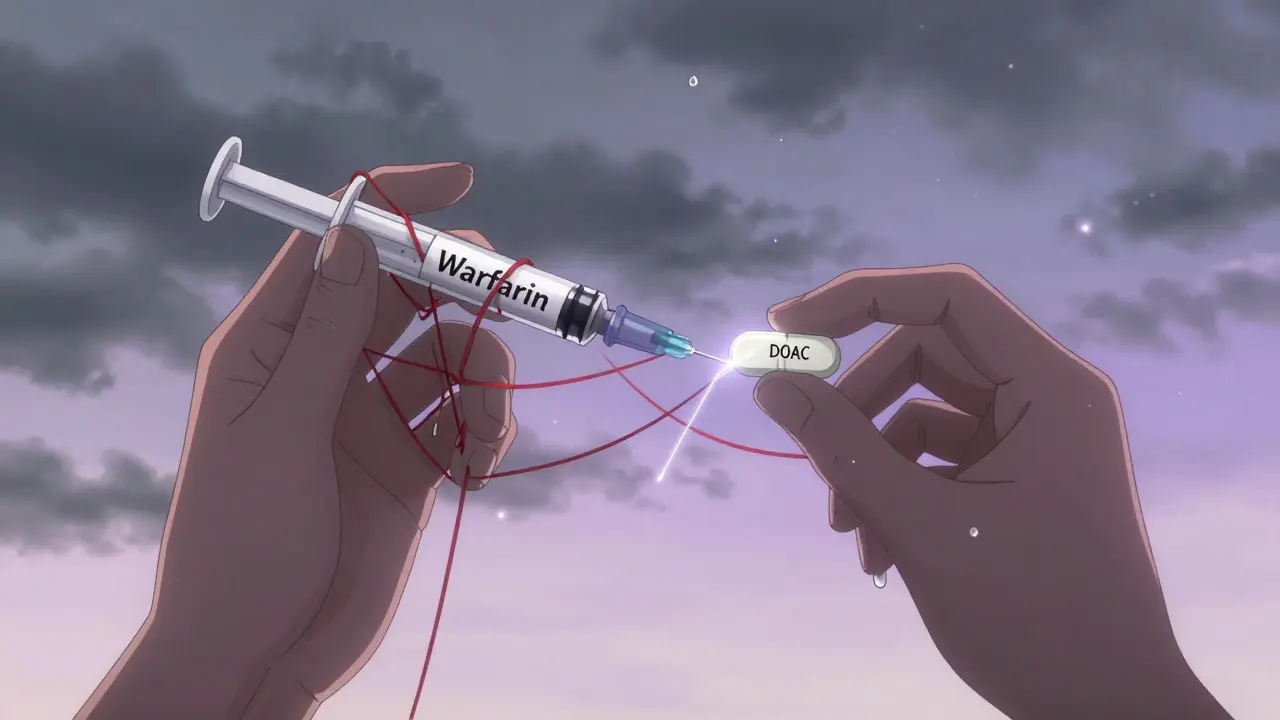
Not all DOACs are the same. Apixaban has the best safety profile. In head-to-head trials, it caused fewer major bleeds than any other DOAC - and fewer than warfarin too. It’s also the most prescribed in the U.S. now, with a 42% market share. Why? Because it’s twice-daily, low-dose, and gentle on the stomach. It’s also the only one with a proven dose reduction for older, smaller, or kidney-impaired patients: 2.5 mg twice daily if you’re over 80, weigh under 60 kg, or have a creatinine level above 1.5.
Dabigatran, on the other hand, has the highest rate of stomach upset. About 1 in 3 users report nausea or bloating. It’s also the only DOAC with a known reversal agent - idarucizumab - that works instantly if someone bleeds badly. That’s why some doctors still pick it for high-risk patients, even with the GI side effects.
Rivaroxaban is once-daily, which helps with adherence. But it’s taken with food, and it’s been linked to slightly higher GI bleeding than apixaban. Edoxaban is the least used - partly because it’s still mostly brand-name, and partly because it’s the only one that requires a dose reduction if you’re on certain heart drugs like verapamil.
Cost used to be the biggest barrier to DOACs. In 2020, brand-name apixaban cost over $650 a month. Now? Generic apixaban hit the market in January 2024. The price dropped to $450-$500. Rivaroxaban and dabigatran generics followed. Warfarin still costs $650 for the drug plus $15-$25 per INR test - about $300-$400 a year in testing alone. So even with the monthly cost, warfarin isn’t always cheaper.
Medicare Part D plans now cover all DOACs with low copays. In fact, many have apixaban at $10 or less per month. That’s why prescriptions for DOACs jumped from 42% of new Afib cases in 2015 to 78% in 2023. The shift isn’t just because doctors like them better - it’s because patients like them better too.
On patient forums, the difference is clear. On PatientsLikeMe, DOAC users gave their meds a 4.2 out of 5. Warfarin users? 3.1. Why? “No more worrying about broccoli,” said one user. “No more monthly blood draws,” said another. One Reddit poster wrote: “Switched from warfarin to apixaban after 10 years. The difference is night and day.”
But it’s not perfect. Some people still get stomach issues with dabigatran. Others worry about what happens if they miss a dose - DOACs leave your system faster than warfarin. If you skip a dose, you’re unprotected within 12-24 hours. That’s why adherence matters more with DOACs. One study found clinics with structured education programs got 85% adherence. Without them? Only 67%.

DOACs are great - but not for everyone.
If you have a mechanical heart valve, DOACs are dangerous. The RE-ALIGN trial showed dabigatran doubled the risk of clots and strokes in these patients. Warfarin is still the only option here.
If you have severe kidney disease - CrCl under 15 mL/min - DOACs aren’t approved. Their safety hasn’t been proven. Warfarin is still used, though it’s risky here too. Some doctors use low-dose warfarin with very tight monitoring.
If you weigh under 60 kg or over 120 kg, DOAC dosing gets tricky. There’s less data. Some experts still prefer warfarin because they can adjust the dose based on blood tests.
And if you’re on drugs that interact badly with DOACs - like strong antifungals or HIV meds - warfarin might be safer. It has more predictable interactions.
All anticoagulants increase bleeding risk. That’s the trade-off. But not all bleeds are the same. A nosebleed? Annoying. A brain bleed? Life-threatening.
Doctors use the HAS-BLED score to assess bleeding risk. Points for high blood pressure, liver or kidney disease, stroke history, labile INR, age over 65, drugs like aspirin, or alcohol abuse. A score of 3 or more means “caution” - not “don’t give anticoagulants.” Most people with a score of 4 or 5 still benefit from treatment. The key is monitoring.
Know the signs: unexplained bruising, pink or red urine, black or tarry stools, vomiting blood, headaches that won’t quit, sudden weakness on one side. If you’re on a DOAC and you fall hard, get checked. Even if you feel fine. Internal bleeding doesn’t always hurt right away.
The future of anticoagulants is here. Milvexian, a new drug targeting factor XIa, showed in 2023 trials that it can prevent strokes just as well as apixaban - but with 22% less bleeding. Abelacimab, a monoclonal antibody, cut major bleeding by 48% compared to apixaban in early trials. These aren’t just tweaks. They’re breakthroughs.
And soon, your genes might decide your drug. Researchers are already testing whether CYP2C9 and VKORC1 gene variants can predict how you respond to warfarin. For DOACs, ABCB1 gene testing might tell you which one works best for your body. Within five years, this could be routine.
For now, the message is simple: if you have nonvalvular Afib and your stroke risk is moderate to high, DOACs are the clear choice. They’re safer, easier, and more effective than warfarin. And with generics now available, cost is no longer a barrier.
Don’t wait for a stroke to make the decision. Talk to your doctor. Ask about your CHA₂DS₂-VASc score. Ask if a DOAC is right for you. This isn’t about taking a pill. It’s about protecting your brain - and your future.
Yes. "Blood thinners" is the common term for anticoagulants. They don’t actually make your blood thinner - they prevent clots from forming by interfering with clotting proteins. Some people also call antiplatelet drugs like aspirin "blood thinners," but those work differently. Anticoagulants like apixaban and warfarin are the ones used for stroke prevention in atrial fibrillation.
Not without talking to your doctor. Even if your Afib seems to have resolved - whether through medication, ablation, or just disappearing - your stroke risk doesn’t vanish overnight. Studies show people who stop anticoagulants after "curing" Afib still have a 2-3% annual stroke risk if their CHA₂DS₂-VASc score was high. Most doctors recommend continuing anticoagulation for at least 2-4 years after Afib resolves, and often longer, depending on your overall risk.
No, routine blood tests aren’t needed for DOACs like apixaban or rivaroxaban. But your doctor will still check your kidney function every 6-12 months - especially if you’re over 75 or have other health issues. That’s because DOACs are cleared through the kidneys. If your kidney function drops too low, your dose may need to be adjusted or switched.
If you miss one dose, take it as soon as you remember - but only if it’s within a few hours of your scheduled time. If it’s almost time for your next dose, skip the missed one and go back to your regular schedule. Don’t double up. DOACs work quickly but leave your system fast. Missing a dose leaves you unprotected for 12-24 hours. That’s why adherence matters more with DOACs than warfarin. Set phone alarms. Use pill organizers. Talk to your pharmacist about tools to help.
Moderate alcohol is usually okay - one drink a day for women, two for men. But heavy drinking increases bleeding risk and can interfere with how your body processes the drug. For warfarin, alcohol can make INR levels swing unpredictably. For DOACs, it’s less of a direct interaction, but chronic heavy use can damage your liver and kidneys, which affects how the drug is cleared. If you drink regularly, tell your doctor. They may adjust your dose or monitor you more closely.
Yes - but only for specific drugs. Idarucizumab (Praxbind) reverses dabigatran within minutes. Andexanet alfa (Andexxa) reverses factor Xa inhibitors like apixaban and rivaroxaban. These are used only in emergencies - like major bleeding or urgent surgery. They’re expensive and not always available in small hospitals. That’s why prevention - avoiding falls, managing blood pressure, knowing bleeding signs - is even more important than reversal.
Usually not. Aspirin is an antiplatelet drug. When combined with anticoagulants, it increases bleeding risk without adding much extra stroke protection. The only exception is if you have both Afib and coronary artery disease, and your doctor has carefully weighed the risks. Even then, most guidelines recommend stopping aspirin after the first few months. Never start or stop aspirin on your own while on a blood thinner.
For most people with nonvalvular atrial fibrillation, it’s lifelong. Afib is a chronic condition. Even if you feel fine, the risk of clot formation doesn’t disappear. Stopping the medication increases stroke risk by 3-5 times. There are rare exceptions - like after successful ablation with no recurrence for over a year - but those decisions require detailed evaluation by a heart rhythm specialist. Don’t assume you’re "cured" just because you feel better.

Henriette Barrows
31 12 25 / 11:07 AMJust switched to apixaban last year after 8 years on warfarin. No more weekly blood draws, no more stressing over kale salads. I can finally eat without a spreadsheet. Life is so much simpler now. 🙌
Fabian Riewe
1 01 26 / 22:43 PMHonestly, the biggest win for me was not having to plan my life around INR checks. I took my wife to Cancún last month without worrying if my blood was too thin or too thick. DOACs gave us back our freedom.
Jasmine Yule
2 01 26 / 13:21 PMPeople act like DOACs are perfect but let’s be real - if you miss a dose, you’re basically naked for 24 hours. I had a fall last winter and panicked for 3 days thinking I was gonna bleed out. Don’t sugarcoat it - adherence is non-negotiable.
Greg Quinn
4 01 26 / 11:33 AMIt’s funny how we treat medicine like a moral choice - ‘I’m on the new drugs, so I’m better.’ But the truth is, we’re all just trying not to die. Warfarin saved lives for 60 years. DOACs just made it less annoying. Neither is a virtue. Both are tools.
Lisa Dore
5 01 26 / 05:49 AMMy dad’s 82, has Afib, kidney issues, and takes 12 meds. His doctor switched him to low-dose apixaban and now he’s hiking again. Don’t underestimate how much this stuff improves quality of life. It’s not just about survival - it’s about living.
Sharleen Luciano
6 01 26 / 18:22 PMUgh. Another article pretending DOACs are magic. Did you mention the 3% annual risk of GI bleeds? Or how dabigatran turns your stomach into a war zone? People think ‘no blood tests’ means ‘no consequences.’ It’s just a different kind of trap.
Jim Rice
7 01 26 / 13:43 PMWarfarin is cheaper. And you can reverse it. DOACs are overpriced corporate hype. My uncle died from a brain bleed on rivaroxaban and they didn’t even have Andexxa at his hospital. This isn’t progress - it’s profit.
Louis Paré
8 01 26 / 00:31 AMLet’s not pretend this is science. The RE-LY trial had cherry-picked endpoints. The real world? 40% of DOAC patients get suboptimal dosing because docs don’t adjust for weight or renal function. You’re not safer - you’re just statistically louder.
Marie-Pierre Gonzalez
10 01 26 / 00:22 AMThank you for this detailed post! 💖 I’m a nurse in Toronto and I’ve seen so many patients transition from warfarin to apixaban - the relief on their faces is priceless. Even with typos (sorry!), this is exactly what people need to hear.
Janette Martens
11 01 26 / 05:00 AMWhy are we all taking American meds? Canada has better guidelines. We don’t just switch because it’s trendy. We assess. We monitor. We don’t let Big Pharma dictate our hearts.
Manan Pandya
11 01 26 / 15:29 PMAs someone from India with limited access to DOACs, I want to say: warfarin is still life-saving where generics aren't available. Cost matters. Access matters. Don’t assume everyone has the luxury of a $10 monthly copay.
Aliza Efraimov
11 01 26 / 23:09 PMI had a stroke in 2020. My CHA₂DS₂-VASc was 5. I was terrified. My cardiologist said, ‘You’re getting apixaban.’ I cried. Not because I was scared - because for the first time in years, I felt like I had control. This isn’t just medicine. It’s hope.
Nisha Marwaha
13 01 26 / 19:24 PMFrom a pharmacogenomics perspective, the CYP2C9/VKORC1 polymorphisms remain clinically relevant for warfarin titration, whereas ABCB1 variants may modulate DOAC bioavailability via P-glycoprotein efflux. The future of precision anticoagulation is not merely algorithmic - it is epigenetically contextualized.
Fabian Riewe
13 01 26 / 20:03 PM@6411 Totally get what you’re saying. I missed a dose once during a road trip and panicked too. Now I keep an extra pill in my glovebox and set 3 alarms. It’s a small price for not having to live like a lab rat.